
By Yasmin Chaudhary — The Inkwell Times
To understand Angola, you must understand resilience. Its history is one of ancient kingdoms, forced displacement, colonial violence, and survival through memory. And like many African nations, Angola carries its history not only in archives—but at the table.
One of the country’s most beloved dishes, Muamba de Galinha, tells that story through flavor, ritual, and continuity.
Angola: A Brief History of Land and Resistance
Angola lies along the southwestern coast of Africa, bordered by the Atlantic Ocean. Long before European contact, the region was home to powerful kingdoms such as the Kingdom of Kongo and Ndongo, with complex political systems, trade networks, and spiritual traditions.
In the late 15th century, Portuguese colonization began—followed by centuries of exploitation and Angola’s central role in the transatlantic slave trade. Entire communities were fractured, yet culture persisted through oral tradition, foodways, and ancestral practice.
Angola gained independence in 1975, but decades of civil war followed. Through it all, Angolans preserved identity through what could not be easily taken away: language, ritual, and food.
The Origins of Muamba de Galinha
Muamba de Galinha is considered Angola’s national dish. At its core, it is a chicken stew built around:
- Palm oil
- Garlic and onion
- Tomatoes
- Okra or leafy greens
- Slow, intentional cooking
The word muamba refers both to the dish and to the palm oil that defines it.
Palm oil has deep roots across Central and West Africa. In Angola, it became essential not only for cooking but for cultural continuity—especially during periods when access to traditional ingredients was limited under colonial rule.
Muamba de Galinha is not festival food alone. It is everyday food. The kind of meal that gathers family, feeds many, and carries memory from one generation to the next.
Why This Dish Matters
Muamba de Galinha reflects Angola’s history:
- Indigenous agricultural knowledge
- Adaptation under colonial pressure
- Community-centered cooking
- Survival through nourishment
Like couscous in Algeria, this dish is not about perfection—it’s about presence.
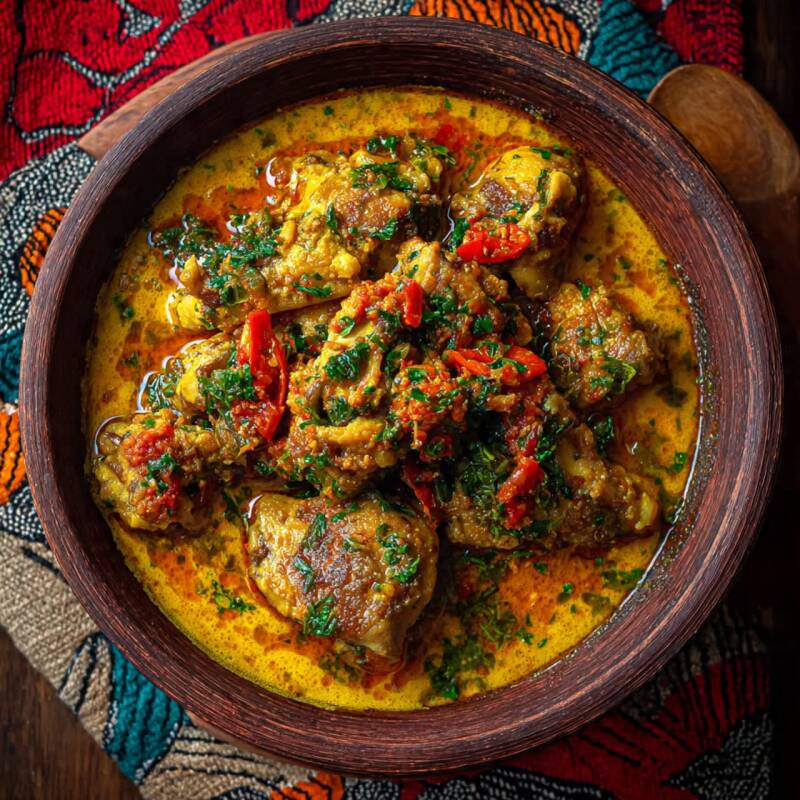
Easy Stovetop Muamba de Galinha (Home-Kitchen Friendly)
As a Pakistani woman, cooking has always been one of the ways I connect to the world. Exploring new dishes—especially those rooted in history and culture—is something I deeply love. For this series, I wanted to honor African countries through food that tells a story, using ingredients that are accessible while remaining respectful to the dish’s origins.
Ingredients
Protein
- 2 lbs chicken (bone-in thighs or drumsticks work best)
Base
- 2 tbsp red palm oil
(If unavailable: half palm oil + half neutral oil, or use all neutral oil with a pinch of smoked paprika for depth) - 1 large onion, chopped
- 4 cloves garlic, minced
Vegetables
- 2 tomatoes, chopped (or 1 can diced tomatoes)
- 1 cup okra, sliced (fresh or frozen)
- Optional: spinach or collard greens
Spices
- 1 tsp paprika
- ½ tsp black pepper
- Salt to taste
- Optional: a pinch of chili flakes
Liquid
- 1½–2 cups chicken broth or water
Instructions
- Brown the chicken
Heat palm oil in a large pot. Season chicken with salt and pepper and brown on all sides. Remove and set aside. - Build the base
In the same pot, sauté onion until soft. Add garlic and paprika; stir until fragrant. - Add tomatoes
Cook tomatoes until they break down and form a rich base. - Simmer
Return chicken to the pot. Add broth, cover, and simmer 30–35 minutes until chicken is tender. - Add okra and greens
Stir in okra and optional greens. Simmer another 10 minutes until vegetables are soft and stew thickens. - Adjust and serve
Taste for salt and spice. Serve hot with rice, fufu, or crusty bread.
A Dish That Carries Memory
Muamba de Galinha is not meant to be rushed. It is slow food born from survival—meant to nourish, to gather, to remind.
In Angola, history lives in this pot.
And that is why it belongs at the table.
Add comment
Comments