Editor’s Note:
This article was originally written around February 10. Due to ongoing health issues, I was unable to review, revise, and edit it within the intended timeframe. Thank you for your patience and understanding as I return to publishing and sharing these stories with the care they deserve.
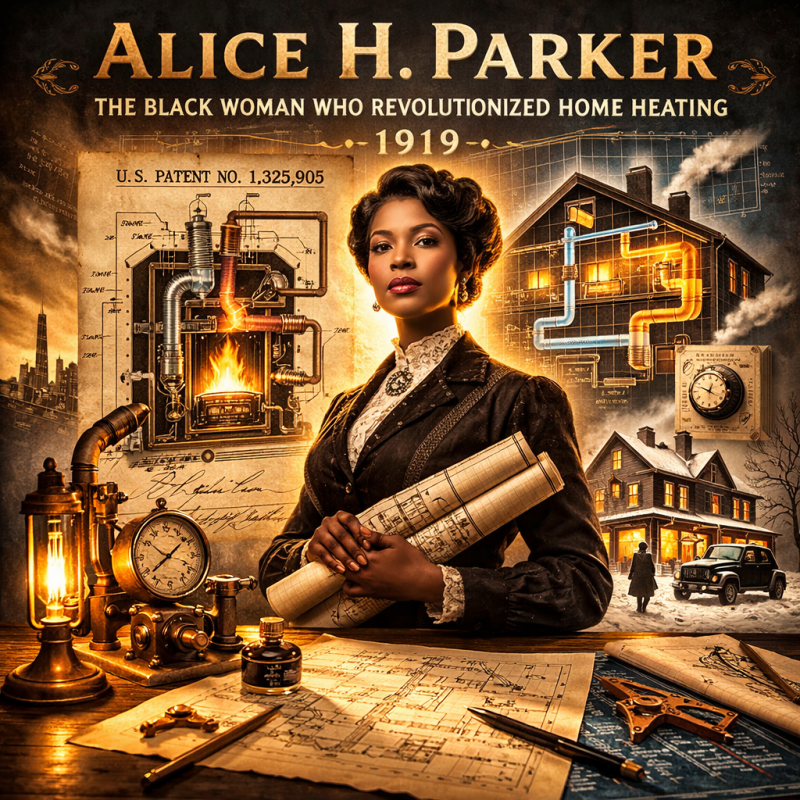
Early Life and Background
Alice H. Parker was an African American inventor born around 1895 in Morristown, New Jersey, during a time when both racial segregation and gender discrimination severely limited opportunities for Black women in science and engineering.
Very little documentation about her life survives — something historians often attribute to the lack of record-keeping for Black women during the early 20th century. Parker attended Howard University Academy, an academic institution connected to Howard University in Washington, D.C., and graduated with honors in 1910 — an impressive achievement for a Black woman in that era.
Records suggest she later worked in domestic service, likely as a cook, while continuing to develop technical ideas — a reminder that innovation does not always come from formal laboratories or privileged positions.
The World Before Her Invention
To understand Parker’s contribution, you have to picture life in the early 1900s.
Most homes were heated by:
- Fireplaces
- Coal-burning furnaces
- Wood stoves
These systems heated only small areas and often created serious fire hazards. Families had to manually feed fuel into the furnace or fireplace throughout the day and night.
Cold winters in New Jersey reportedly inspired Parker to imagine a safer, more efficient way to warm an entire house.
The 1919 Patent: A New Vision of Heating
On December 23, 1919, Parker received U.S. Patent No. 1,325,905 for an “Improved Heating Furnace.”
Her design introduced several forward-thinking ideas:
1. Natural Gas Instead of Coal or Wood
Rather than relying on bulky fuels, Parker proposed using natural gas — cleaner, easier to regulate, and less labor-intensive.
2. Multiple Independently Controlled Burners
Her system allowed heat to be distributed through ducts into different rooms, with separate control over each section — an early concept similar to modern zone heating.
3. Regulated Airflow and Heat Exchange
Cold air would be drawn into the furnace, heated, and then pushed through a network of ducts — a principle that would later become standard in forced-air heating systems.
These ideas were incredibly advanced for 1919, essentially outlining a blueprint for how modern HVAC systems operate.
Did She Invent Central Heating?
This is where history gets nuanced.
Central heating existed long before Parker — even ancient Roman hypocaust systems circulated warm air under floors. What Parker did was reimagine heating using natural gas and controlled airflow, which influenced later technological developments.
Her design:
- Was not the first furnace ever made
- Was not widely manufactured at the time
- But introduced new engineering concepts that inspired future systems
Many historians describe her work as a precursor to modern thermostats, forced-air furnaces, and zoned temperature control.
Why Her System Wasn’t Mass-Produced
Despite its innovation, Parker’s furnace never entered large-scale production
The main reasons were:
- Safety concerns about regulating gas heat flow with the technology available at the time
- Limited infrastructure for natural gas in many cities
- Engineering challenges that later inventors would need to solve
Even so, her patent helped guide the direction of heating technology throughout the 20th century.
Barriers She Faced as a Black Woman Inventor
To file a patent in 1919 required:
- Technical drawings
- Engineering descriptions
- Legal paperwork
- Financial resources
For a Black woman living before the Civil Rights Movement — and before women gained full voting rights — navigating that process was remarkable.
Many historians view Parker as a “hidden figure” whose contributions were overshadowed because of the social barriers of her time.
Legacy and Recognition
Although details of Parker’s later life remain uncertain — some sources suggest she may have died around 1920 — her legacy has grown in recent decades as historians revisit overlooked inventors. I
Her influence can be seen in:
- Zoned heating systems
- Modern thermostats
- Forced-air furnaces
- Energy-efficient HVAC design
In 2019, organizations such as the National Society of Black Physicists honored her contributions, and the Alice H. Parker Women Leaders in Innovation Award was created in her home state of New Jersey.
Why Alice Parker Still Matters Today
Alice H. Parker’s story is powerful not because she single-handedly invented heating — but because she pushed heating technology forward at a time when Black women were rarely allowed into technical spaces.
Her work represents:
- Visionary engineering during a period of limited resources
- Innovation driven by everyday needs
- The quiet brilliance of inventors history nearly forgot
Every time a thermostat adjusts the temperature in different rooms, or a forced-air system distributes warmth evenly through a home, there’s a trace of the ideas Parker explored over a century ago.
Add comment
Comments