Editor’s Note — 21 February 2026
This article is published on the anniversary of the assassination of Malcolm X, sixty-one years after his death. This is not a retrospective for nostalgia, nor a retelling of tragedy for consumption. It is an act of remembrance, reflection, and respect.
Malcolm X was a man in motion—still learning, still evolving, still challenging power when his life was taken. This piece honors the fullness of who he was: his convictions, his growth, his service to the Black community, and the unfinished liberation he left behind.
May his words continue to be studied with honesty, not fear.

Artist: T. A. Charron
By Yasmin Chaudhary — The Inkwell Times
Innā lillāhi wa innā ilayhi rājiʿūn.
Indeed, we belong to God, and to Him we return.
“O Allah, forgive him and have mercy on him.
Expand his grave and fill it with light.
Count his struggle among those who stood for justice.
Accept his intentions, even where the world misunderstood him.
Grant him peace among the righteous.”
It has been sixty-one years since Malcolm X was taken from this world. Sixty-one years is not a long time. Not when the wounds he named are still open. Not when the systems he fought remain intact. Not when the questions he asked still make people uncomfortable.
Malcolm X did not die as history. He died as a warning—and as a legacy still in motion.
A Boy the World Tried to Break
Malcolm X was born Malcolm Little in 1925, into a world already hostile to his existence. His father, a Black nationalist preacher, was harassed relentlessly by white supremacist groups and died under suspicious circumstances. His mother, worn down by grief, poverty, and state interference, was institutionalized. Malcolm and his siblings were scattered through foster care.
The message was clear long before Malcolm had words for it: Black life was disposable.
This early violence was not just personal—it was systemic. It shaped the clarity with which Malcolm would later speak about racism as something embedded, not accidental.
From Survival to Awakening
Malcolm’s early adulthood followed a familiar pattern for Black men locked out of opportunity: street economies, incarceration, erasure. But prison became a site of transformation. There, Malcolm educated himself obsessively—reading history, philosophy, religion, and politics.
More importantly, he learned to name the forces that had shaped his life.
This awakening led him to the Nation of Islam, where he would rise as one of the most powerful orators of the 20th century.
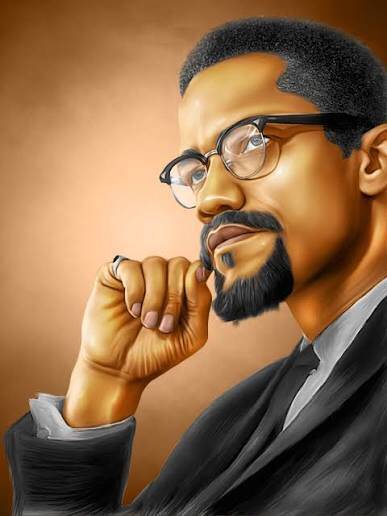
Art By:Get Custom Art
Giving Voice to the Unheard
Malcolm X’s greatest early contribution to the Black community was psychological.
He told Black people—especially those written off as “too angry,” “too poor,” or “too lost”—that they were not failures. He reframed rage as a rational response to violence. He rejected the demand that Black people prove their humanity through patience and politeness.
For those who had never seen themselves reflected in mainstream civil rights leadership, Malcolm spoke directly to their lived reality.
This was not empty rhetoric. It was restoration.
Self-Defense, Not Hatred
Malcolm X is often mischaracterized as promoting violence. This is historically inaccurate.
What he advocated was self-defense—the same right granted unquestioningly to others. He rejected the idea that nonviolence should mean passivity in the face of brutality. For Black communities terrorized by police and vigilantes, this stance was not radical—it was practical.
His position forced America to confront an uncomfortable truth: the state could not demand peace from people it refused to protect.
Growth That Threatened Power
One of Malcolm X’s most profound acts was his willingness to change.
After leaving the Nation of Islam, he traveled extensively, including a pilgrimage to Mecca. There, he encountered a global Muslim community that challenged parts of his earlier worldview. He returned with a broader vision—one that linked the Black American struggle to global movements against colonialism and oppression.
He began to speak not just of civil rights, but of human rights.
This evolution made him more dangerous than ever.
A Malcolm X who could build coalitions, speak internationally, and expose U.S. racism on the world stage was a threat not just to white supremacy, but to any system invested in keeping Black resistance fragmented.
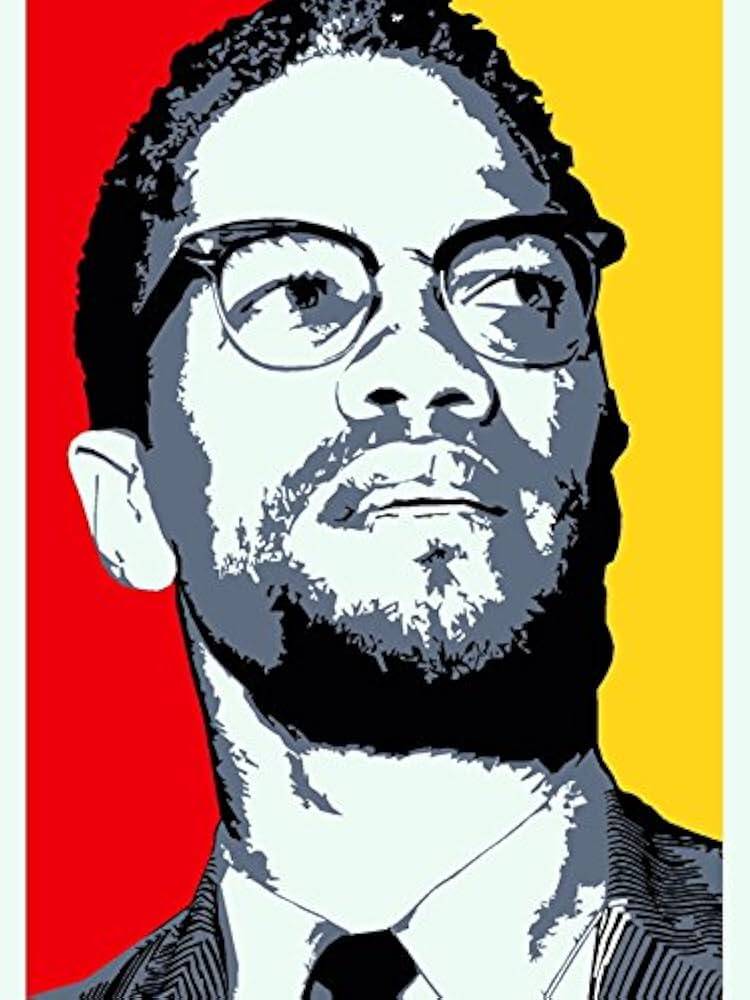
Artist: Unknown Art Sold By:Amazon
Surveillance, Isolation, and Betrayal
Malcolm X was among the most surveilled Black leaders in U.S. history. Government agencies monitored him closely, tracked threats against his life, and failed to intervene when danger became imminent.
At the same time, he faced hostility from former allies, was stripped of protection, and left vulnerable.
On February 21, 1965, he was assassinated while preparing to speak in Harlem.
Yes—Black men pulled the trigger.
But violence does not occur in a vacuum.
Internal fractures do not emerge by accident. They are often cultivated, exploited, and left to rot by systems that benefit from division.
What Malcolm X Gave the Black Community
Malcolm X gave Black America:
- Language for systemic racism before it was widely acknowledged
- A framework for dignity rooted in self-respect, not approval
- A global perspective on liberation
- Permission to grow, revise, and evolve publicly
- Courage to speak truth even when it costs everything
He did not promise comfort.
He promised clarity.
Sixty-One Years Is Not a Long Time
Malcolm X was only thirty-nine years old when he was killed.
We often speak of him as a finished chapter, but his work was interrupted. His thinking was still unfolding. His vision was still widening.
To remember Malcolm X honestly is not to freeze him in anger or martyrdom. It is to honor his humanity—his mistakes, his brilliance, his transformation, and his unwavering demand that Black lives be treated with truth.
Closing Reflection
Malcolm X did not ask to be liked.
He asked to be heard.
He did not ask for patience.
He demanded justice.
And sixty-one years later, as his death date approaches once more, we do not mark time—we mark responsibility.
May his soul rest in peace.
May his words continue to unsettle injustice.
And may we finally listen to what he was trying to tell us.
Add comment
Comments