Editor’s Note:
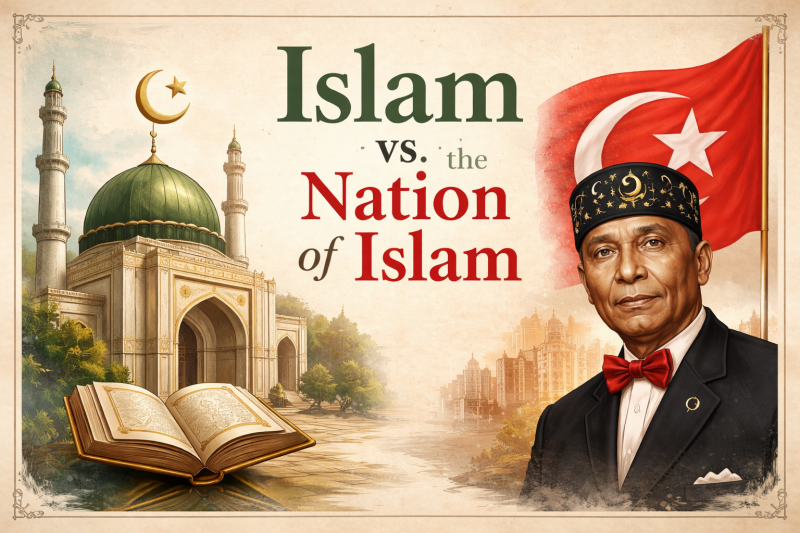
Discussions of the Nation of Islam and its leadership often exist at the intersection of historical progress and moral controversy. This article distinguishes between Islam as a global faith and the Nation of Islam as a uniquely American movement. It also acknowledges that early Nation of Islam leadership, including Elijah Muhammad, contributed to Black self-determination and community discipline during a period of severe racial oppression—while recognizing that unchecked authority, internal contradictions, and refusal to confront violence ultimately undermined that legacy. Historical accuracy requires holding both truths at once.
By Yasmin Chaudhary — The Inkwell Times
Why This Distinction Matters
In the United States, Nation of Islam (NOI) is often incorrectly treated as synonymous with Islam. This confusion has fueled decades of misunderstanding, prejudice, and inaccurate historical narratives—particularly when discussing Malcolm X and his assassination.
The two are not the same religion, do not share the same theology, and do not represent the same global faith tradition.
What Is Islam?
Islam is a monotheistic Abrahamic religion founded in the 7th century in Arabia.
Core beliefs include:
- One God (Allah) — indivisible, with no human form
- Muhammad ﷺ as the final prophet (following Abraham, Moses, Jesus, and others)
- The Qur’an as the literal word of God
- Equality of all races and ethnicities
- Five Pillars of Islam: faith, prayer, charity, fasting, pilgrimage
Islam is practiced globally by over 1.9 billion people across every race and culture. There is no racial hierarchy in Islamic theology.
What Is the Nation of Islam?
The Nation of Islam is a U.S.-based religious and political movement, founded in 1930 in Detroit by Wallace Fard Muhammad.
Key characteristics:
• Developed in response to systemic racism and segregation faced by Black Americans
• Combined religious language with Black nationalist ideology
• Taught that Black people were the original people of the earth
• Included beliefs not found in Islam, such as:
• Wallace Fard Muhammad being divine or semi-divine
• A racially specific theology
• Rejection of traditional Islamic scholarship
The NOI’s theology diverges sharply from mainstream Islam.
Elijah Muhammad and Leadership
Under Elijah Muhammad, the NOI expanded significantly during the mid-20th century.
However:
- His teachings contradicted Islamic monotheism
- His personal conduct (including secret relationships) conflicted with his moral authority
- His leadership became a point of internal crisis for many members
These contradictions deeply affected Malcolm X.
Malcolm X’s Break from the Nation of Islam
Malcolm X left the Nation of Islam in 1964.
After completing the Hajj pilgrimage to Mecca, he publicly stated that:
- Islam transcended race
- He prayed alongside Muslims of all ethnicities
- The NOI’s racial theology was incompatible with true Islam
By the time of his assassination in 1965, Malcolm X was a Sunni Muslim, not a member of the Nation of Islam.
The Assassination and Historical Responsibility
Three men associated with the NOI were convicted of Malcolm X’s murder. Decades later, investigations revealed wrongful convictions and government failures, but the context remains important:
- The assassination occurred after Malcolm left the NOI
- It was tied to internal conflict, not Islamic doctrine
- It cannot be attributed to Islam as a religion
Blaming Islam for Malcolm X’s death is historically and theologically incorrect.
Why the Confusion Persists
Several factors contribute:
- The word “Islam” in the NOI’s name
- Media oversimplification
- Cold War–era racial politics
- Lack of religious literacy in the U.S.
This confusion often fuels anti-Muslim prejudice, particularly toward American Muslims who have no connection to the NOI.
Conclusion
Islam and the Nation of Islam are distinct in origin, theology, and practice.
- Islam is a global faith rooted in monotheism and racial equality
- The Nation of Islam is a uniquely American movement shaped by racial injustice
- Malcolm X’s legacy belongs to Islam, not the ideology he left behind
Understanding this distinction is not about defending one group over another—it’s about historical accuracy.
Add comment
Comments