Editor’s Note — 6 February 2026
This piece is published in reflection on the enduring legacy of Martin Luther King Jr. and the continued struggle for justice in America. His dream reshaped the nation, but its fulfillment remains unfinished.
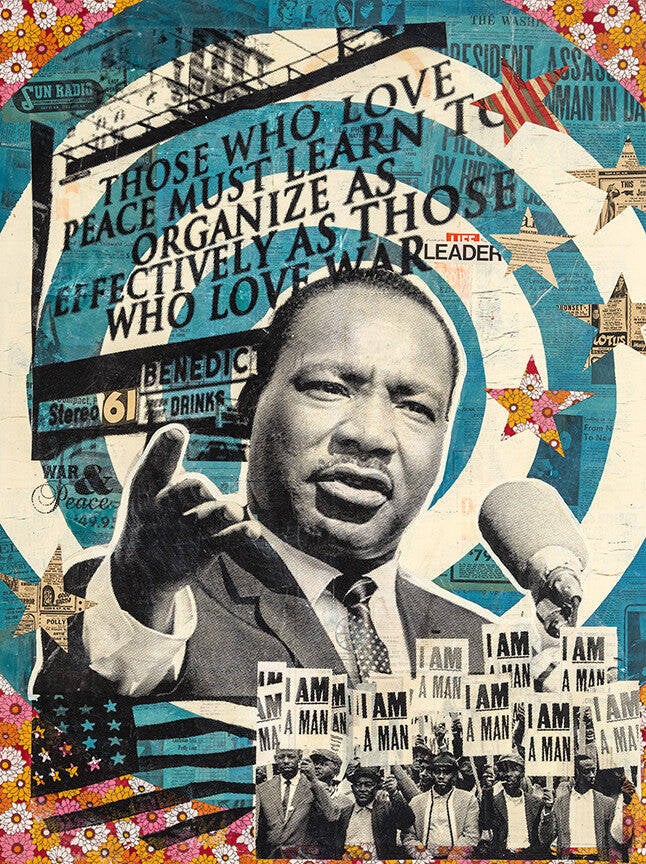
Artist: Robert Mars; Painting: War & Peace
By Yasmin Chaudhary — The Inkwell Times
Martin Luther King Jr. is often remembered in fragments: a dream, a march, a quote pulled out of context. What gets lost in that flattening is the enormity of his labor—and the radical courage it took to demand justice from a nation built on inequality.
Dr. King did not simply inspire hope. He forced structural change.
And that is precisely why he became a target.
A Moral Vision Rooted in Action
Dr. King emerged as a leader during a time when Black Americans were systematically denied basic human rights—through segregation, voter suppression, racial terror, and economic exclusion. As a Baptist minister, he framed civil rights not just as a political issue, but as a moral crisis.
His commitment to nonviolent resistance was not passive. It was strategic.
Through boycotts, marches, sit-ins, and mass mobilization, Dr. King exposed the brutality of white supremacy by forcing it into public view. When peaceful demonstrators were met with dogs, fire hoses, batons, and bullets, the moral contradiction of America became impossible to ignore.
Nonviolence, in King’s hands, was confrontation.
Transforming the Law of the Land
Dr. King’s leadership was instrumental in achieving some of the most consequential legislation in U.S. history:
- The Civil Rights Act of 1964, which outlawed segregation in public spaces and banned employment discrimination
- The Voting Rights Act of 1965, which dismantled many legal barriers preventing Black Americans from voting
These were not symbolic wins. They fundamentally altered the legal structure of the nation.
Millions of people today—across races and identities—benefit from protections born out of the Civil Rights Movement. Workplace equality laws, voting protections, and anti-discrimination frameworks all trace back to the pressure created by King and those who marched beside him.
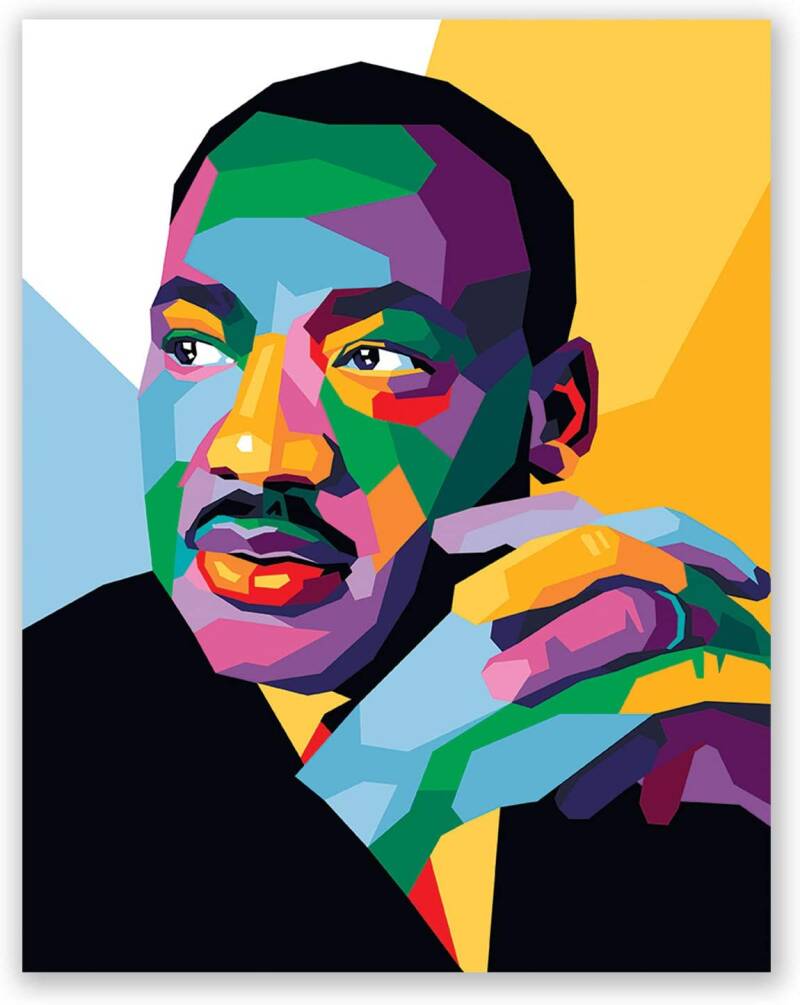
Artist: Unknown; Sold By:Pinot’s Palette
Beyond Integration: Economic Justice and the Poor People’s Campaign
What is often omitted from mainstream narratives is how Dr. King’s vision expanded near the end of his life.
He began speaking openly about:
• Economic inequality
• Labor exploitation
• Poverty across racial lines
• The failures of American capitalism
The Poor People’s Campaign sought to unite Black, white, Latino, and Indigenous communities around shared economic injustice. This coalition-building made many in power deeply uncomfortable.
Dr. King understood that civil rights without economic justice would always be fragile.
Opposition to the Vietnam War: A Dangerous Stand
In 1967, Dr. King publicly condemned the Vietnam War, calling the U.S. government “the greatest purveyor of violence in the world today.”
This stance cost him:
- Political allies
- Media support
- Financial backing
But he refused to separate racial justice at home from violence abroad. For Dr. King, morality was not selective.
This made him more radical—and more dangerous to entrenched power—than the version of him often taught in classrooms.

Artist: Unknown; Sold By:Pinot’s Palette
The Assassination of Dr. King
On April 4, 1968, Dr. King was assassinated while standing on the balcony of the Lorraine Motel in Memphis, where he had gone to support striking sanitation workers—Black men demanding dignity and fair wages.
His death was not random.
It came at a moment when his activism threatened economic and political systems simultaneously.
The assassination of Martin Luther King Jr. was not just the killing of a man—it was an attempt to halt a movement that was expanding beyond what the nation was willing to confront.
The Dream vs. the Reality of Today
Dr. King dreamed of a society where people would not be judged by the color of their skin—but the conditions facing Black men today reveal how incomplete that dream remains.
Black men are:
- Disproportionately incarcerated
- More likely to be stopped, searched, and killed by police
- More harshly sentenced for the same crimes
- Systematically surveilled and criminalized
This is not a moral failure of individuals.
It is a structural failure of the state.
Dr. King warned against this. He cautioned that laws alone would not transform hearts—or dismantle systems designed to oppress.
Why Dr. King Still Matters
Martin Luther King Jr. did not offer comfort. He offered accountability.
He demanded that America live up to its own ideals—and exposed how violently it resisted doing so.
His legacy is not frozen in a dream. It lives in protest movements, voting rights battles, labor organizing, and ongoing fights against mass incarceration.
To honor Dr. King is not just to quote him. It is to continue the work he was killed for.
Closing Reflection
Martin Luther King Jr. believed in justice even when justice cost him everything.
He believed that nonviolence could confront brutality. That moral clarity could expose power. That a nation could be transformed—if it was forced to face itself.
His dream reshaped America. But the dream remains unfinished.
And the responsibility to carry it forward belongs to us.
Add comment
Comments