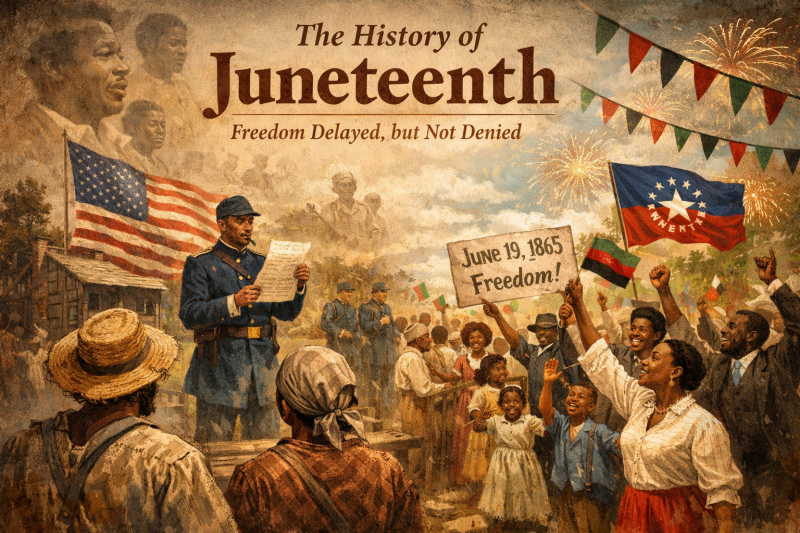
By Yasmin Chaudhary — The Inkwell Times
June 19, 1987 — Birth Date Note:
June 19 carries a personal meaning for me as well. I was born on this date in 1987, the same day that now holds historical significance as Juneteenth in the United States. As a Pakistani-American, I was once told I cannot participate in Juneteenth celebrations, and I understand the importance of respecting cultural and historical boundaries. At the same time, I believe there is space to honor the history, reflect on its meaning, and recognize the people whose lives and struggles are tied to it.
Juneteenth is one of the most important milestones in American history—a day that represents both the delayed reality of freedom and the resilience of those who endured slavery in the United States.
It is not just a historical date. It is a lived memory, passed down through generations, rooted in pain, survival, and eventual liberation.
The Promise of Freedom (1863)
The story begins during the American Civil War. On January 1, 1863, President Abraham Lincoln issued the Emancipation Proclamation, declaring that all enslaved people in Confederate states were legally free.
But there was a major limitation: the proclamation only applied where the Union had control. In places still under Confederate rule, slavery continued.
That gap between law and reality is what makes Juneteenth so significant.
June 19, 1865: Freedom Finally Reaches Texas
Even after the Confederacy began to collapse in 1865, enslaved people in Texas remained in bondage—largely isolated from enforcement of emancipation.
On June 19, 1865, Union General Gordon Granger arrived in Galveston, Texas and issued General Order No. 3. This order announced that all enslaved people in Texas were free and that slavery was officially abolished.
For more than 250,000 enslaved African Americans in Texas, this was the moment freedom finally became real—not just written.
That day became known as “Juneteenth,” blending “June” and “nineteenth.”
Early Celebrations and Community Memory
The first Juneteenth celebrations began in Texas in 1866, just one year after emancipation was enforced there.
These early gatherings often included:
- Prayer services and religious reflection
- Family reunions (many families had been separated by slavery)
- Food traditions passed down through generations
- Education efforts, since enslaved people were previously denied formal schooling
As Black families migrated out of Texas during the Great Migration, they carried Juneteenth traditions across the United States, planting the roots of a national observance.
Suppression, Survival, and Cultural Strength
For decades, Juneteenth was not widely recognized outside Black communities—and in some places, it was actively ignored or discouraged.
Yet it persisted quietly through:
- Church gatherings
- Community festivals
- Oral storytelling
- Local celebrations in Black neighborhoods
This endurance is a key part of its history: Juneteenth survived not because institutions preserved it, but because communities did.
The Civil Rights Era and Renewed Recognition
During the Civil Rights Movement of the 1950s and 1960s, Juneteenth gained renewed visibility as activists drew connections between emancipation and ongoing struggles for equality.
In 1979, Texas became the first state to make Juneteenth an official state holiday. Over time, more states followed.
The movement toward national recognition grew steadily in the following decades, driven by educators, historians, and community leaders who pushed to preserve the story.
A National Holiday (2021)
In 2021, Juneteenth was officially recognized as a U.S. federal holiday. This marked a historic moment—more than 150 years after emancipation reached Texas.
The designation acknowledged what many communities had long known: Juneteenth is not just symbolic—it is foundational to understanding American freedom.
What Juneteenth Represents Today
Juneteenth is often described as a second Independence Day in the United States, but it carries a deeper emotional weight. It reflects:
- The gap between law and lived experience
- The resilience of enslaved and formerly enslaved people
- The importance of memory in shaping justice
- The ongoing conversation about equality in America
It is a day of both celebration and reflection—honoring freedom while recognizing the cost at which it came.
Participation, Respect, and Cultural Understanding
There are many perspectives on who “can” participate in Juneteenth. In practice, Juneteenth is increasingly observed as both a cultural and national moment of remembrance in the United States.
What matters most is intention: approaching the day with respect for its origins and the people whose history it carries.
Honoring Juneteenth does not require claiming ownership of it. For many, it simply means acknowledging the truth of history, recognizing the suffering endured, and respecting the significance of freedom that was long delayed.
Add comment
Comments