by Yasmin Chaudhary — The Inkwell Times
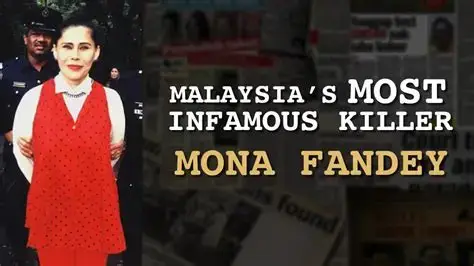
Few criminal cases have captured the public’s imagination quite like the story of Mona Fandey. Part celebrity, part spiritual healer, and eventually convicted murderer, her name has become synonymous with one of Malaysia’s most shocking crimes. More than three decades later, the case continues to inspire documentaries, books, podcasts, and even horror films.
But behind the myths, rumors, and tales of black magic lies a disturbing story driven by greed, manipulation, and violence.
Who Was Mona Fandey?
Born Nur Maznah Ismail in 1956, Mona Fandey initially pursued a career in music. Although she released several songs and performed as a pop singer during the 1980s, commercial success remained limited. Seeking a new path, she and her husband, Mohamad Nor Affandi Abdul Rahman, reinvented themselves as bomohs—traditional Malay spiritual healers who claim to offer supernatural assistance through rituals, charms, and spiritual guidance.
While many bomohs practice forms of traditional healing that are deeply rooted in Malaysian culture, some individuals claim to possess extraordinary mystical powers. Mona and her husband cultivated an image of wealth, influence, and supernatural ability, attracting clients who hoped to gain success, love, protection, or political power.
A Politician Seeking Power
In 1993, Mazlan Idris, a Malaysian state assemblyman, reportedly sought Mona’s help in advancing his political ambitions.
According to prosecutors, Mona convinced him she could perform a ritual that would ensure his rise to higher political office. The ritual allegedly required significant payments, and Mazlan eventually withdrew hundreds of thousands of Malaysian ringgit before meeting Mona and her associates. Prosecutors later argued that he believed he was participating in a ceremony that would bring him success—not walking into a carefully planned murder.
The Murder
Investigators determined that Mazlan was lured to an isolated property in Pahang under the guise of a spiritual ritual.
Court testimony described how he was instructed to lie down, close his eyes, and wait for supernatural signs. Instead, he was attacked and killed. His body was later dismembered into 18 pieces and buried beneath a cement floor inside an unfinished house. Police also recovered ritual objects, knives, and an axe from the scene.
The brutality of the killing horrified Malaysia and quickly dominated national headlines.
How Police Solved the Crime
The investigation took a dramatic turn after Mona’s assistant, Juraimi Hassan, was arrested on an unrelated drug offense.
During questioning, information provided by the suspects eventually led police to the burial site. After excavating beneath the concrete floor, investigators discovered human remains. Dental records later confirmed that the victim was Mazlan Idris.
Authorities also noted that shortly after Mazlan disappeared, Mona embarked on an extravagant spending spree, purchasing luxury items—including a Mercedes-Benz—with large amounts of cash. Prosecutors argued these purchases were funded using the victim’s money.
The Trial
The trial began in 1994 and became one of Malaysia’s most closely watched court proceedings.
Throughout the trial, Mona displayed behavior that many observers found unsettling. Rather than appearing fearful or remorseful, she frequently smiled, posed for photographers, and seemed to enjoy the intense media attention.
After she, her husband, and Juraimi Hassan were convicted of murder in February 1995, Mona famously told reporters:
“I am happy with the decision.”
She then reportedly blew kisses toward journalists and spectators.
Her unusual courtroom demeanor only fueled public fascination and helped cement her place in Malaysian criminal history.
Execution
After multiple appeals failed, Mona Fandey, her husband, and Juraimi Hassan were executed by hanging on November 2, 2001, at Kajang Prison.
According to reports, Mona remained calm until the very end. One of the most enduring stories from the execution is the claim that she declared:
“Aku takkan mati.”
The phrase translates to “I will never die.” Whether interpreted literally or symbolically, those words have become inseparable from her legacy.
Fact vs. Legend
Over time, countless supernatural stories have emerged surrounding the case.
Some claim Mona possessed genuine mystical abilities. Others insist she could cast spells, levitate, or curse those who opposed her. Stories of haunted homes and paranormal encounters continue to circulate online and in popular culture.
However, no credible evidence has ever supported claims that supernatural forces played any role in the crime. Investigators built their case on physical evidence, witness testimony, financial records, and forensic findings—not the paranormal.
Separating folklore from documented facts is important, particularly in a case that has become heavily mythologized over the years.
Cultural Impact
The Mona Fandey case left a lasting mark on Malaysian society.
It remains one of the country’s most notorious murder cases and has been referenced in books, podcasts, television programs, and true crime documentaries. The controversial Malaysian horror film Dukun was inspired by the case. Although completed years earlier, the film’s release was delayed for more than a decade due to concerns about its similarities to the real-life events.
The sensational nature of the trial also coincided with the end of Malaysia’s jury system. While the decision to abolish jury trials involved multiple factors, Mona Fandey’s highly publicized case is often cited as one of the country’s last major jury trials.
A Case That Refuses to Fade
More than twenty years after her execution, Mona Fandey continues to fascinate true crime enthusiasts worldwide.
Was she a calculating con artist who exploited vulnerable people for money? A fame-seeker who embraced notoriety? Or simply the central figure in a crime that became larger than life through media coverage and folklore?
Whatever the answer, one fact remains undeniable: the murder of Mazlan Idris forever transformed Mona Fandey from a little-known pop singer into one of Southeast Asia’s most infamous criminals.
The myths surrounding her may never disappear—but the documented evidence tells a story far more disturbing than any ghost tale: one of deception, ambition, and a brutal murder committed in pursuit of wealth and power.
Add comment
Comments
This was a fascinating read. I had heard Mona Fandey’s name before but never knew the full story. It’s incredible how fact and folklore became so intertwined in this case.
The details about the investigation were especially interesting. It’s a reminder that some of the most shocking true crime cases don’t need embellishment—they’re disturbing enough on their own.
I appreciate that this article separated documented facts from the supernatural rumors. That made it much more informative than many videos and posts I’ve seen online.
Excellent overview of one of Southeast Asia’s most infamous murder cases. The historical context and cultural impact sections added a lot beyond just recounting the crime.