by Yasmin Chaudhary — The Inkwell Times
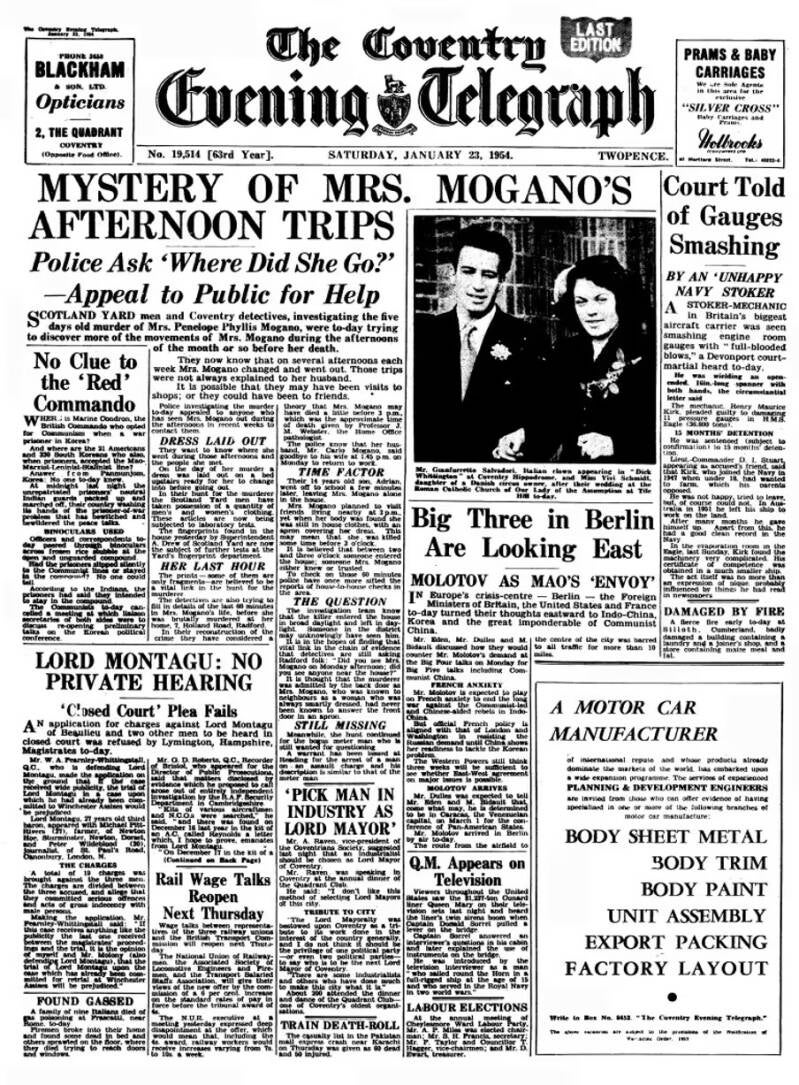
On January 18, 1954, 44-year-old Penelope Phyllis Mogano was at home on Holland Road in Radford, Coventry.
By the end of that afternoon, she would be dead.
Her murder became one of Coventry’s most enduring unsolved mysteries. Police conducted an enormous investigation, questioned thousands of people, pursued numerous leads and even brought in detectives from Scotland Yard. Yet after more than seven decades, the person responsible has never been identified.
What happened inside the Mogano home that afternoon remains a mystery.
A quiet afternoon turns deadly
Penelope lived at 7 Holland Road with her husband, Carlo, and their two sons.
She was known in her community and was involved with local social activities, including the Radford Townswomen’s Guild and the old-time dancing scene. Her afternoons were generally her own, and investigators would later become interested in how she had been spending them.
On January 18, Penelope apparently intended to go out at around 3 p.m. Clothes had reportedly been laid out for her to change into.
She never left the house.
Around 5 p.m., one of her sons arrived home from school but found the house locked. Later, Carlo returned from work.
When he entered the house, there was initially little to suggest that anything terrible had happened.
The kitchen was reportedly tidy. The dishes from lunch had been washed. There was no obvious sign of a burglary or a struggle throughout the home.
But the evening meal had not been prepared, and the fire had not been lit.
Then Carlo discovered his wife.
Penelope was sitting in an armchair in the dining room.
She was dead.
A horrific attack
Penelope had suffered severe injuries to her head. Investigators believed that she had been attacked with a blunt instrument, probably a hammer.
A carving knife was also found at the scene. It had apparently been used to inflict injuries to her face and tongue.
The suspected hammer was never recovered.
Penelope had defensive injuries, suggesting that she had fought against her attacker.
The violence of the killing was shocking, particularly because there appeared to be no obvious motive for the attack.
Nothing indicated that the house had been systematically ransacked, and robbery did not appear to explain the killing.
There was also no evidence establishing a sexual assault.
The question became simple but extraordinarily difficult to answer:
Who would want Penelope Mogano dead—and why?
The door that may have been opened willingly
One of the most important details of the investigation was the apparent absence of forced entry.
Police reconstructed the crime scene and considered the possibility that Penelope had allowed her killer—or killers—into the house.
That raised the possibility that she knew the person who attacked her.
But this was never proven.
It is important not to turn that investigative theory into a certainty. A lack of forced entry can suggest that a victim admitted someone voluntarily, but it does not necessarily establish a relationship between victim and attacker.
Carlo reportedly struggled to understand who could have wanted to harm his wife. He maintained that there were no obvious secrets between them.
Carlo Mogano was questioned
As would be expected in a murder investigation involving a woman killed inside her own home, police examined her husband closely.
Carlo was subjected to lengthy questioning—one account reports an interrogation lasting approximately ten hours.
He was eventually released and was not charged with his wife’s murder.
There is no evidence that Carlo was subsequently prosecuted for Penelope’s death.
He lived for another three decades, dying in 1986 without knowing who had murdered his wife.
Penelope’s mysterious afternoons
One of the more intriguing aspects of the investigation concerned Penelope’s activities before her death.
Investigators learned that she had apparently been making regular afternoon trips in the weeks leading up to the murder.
Exactly where she went and whom she met remained unclear.
Penelope had resigned from the Radford Townswomen’s Guild in late 1953, reportedly explaining that she wanted to rest during the afternoons.
There has been speculation over whether these unexplained outings were connected to her death.
However, there is no established evidence that Penelope was conducting an affair or secretly involved in anything sinister.
The truth is simply that investigators could not fully account for her movements.
And that uncertainty has fueled speculation about the case ever since.
Another strange lead emerged on the very day Penelope was murdered.
A man reportedly visited a home less than 200 yards from the Moganos’ house, claiming to be there to inspect or read the electricity meter.
Once inside, he allegedly made sexual advances toward the woman who answered the door.
The man was reportedly described as having dark hair, a London accent and a dirty dark-blue overcoat.
Police investigated whether he might have been connected to Penelope’s murder.
But no connection was established.
He was never conclusively identified as Penelope’s killer.
The possibility that he was simply an unrelated prowler or sexual offender cannot be ruled out.
Fires, dancing and possible connections
Investigators also looked at a series of suspicious incidents involving fires.
A nearby house had reportedly been entered and a pantry deliberately set alight. The owner was also connected to the local old-time dancing community.
There had additionally been an earlier attempt to set fire to the Moganos’ car.
These incidents naturally attracted investigators’ attention.
Could they have been connected to Penelope’s murder?
It was never established.
The fact that several people connected to the dancing community appeared in the wider investigation has also contributed to theories about whether Penelope’s social circle might somehow have been relevant.
But again, there is no conclusive evidence tying the fires to her killing.
One of Coventry’s biggest murder investigations
The scale of the investigation was extraordinary.
Police reportedly obtained more than 25,000 statements while attempting to establish what had happened.
Investigators canvassed the neighborhood and questioned people whose work brought them into the area, including delivery workers and tradesmen.
They were looking for anyone who might have seen Penelope—or a suspicious stranger—around Holland Road that afternoon.
Scotland Yard detectives also became involved.
Despite the enormous effort, the investigation failed to produce a murderer.
The case eventually reached the point where police suspected that the person responsible might actually have been among those already questioned.
There was even a theory that somebody knew who had committed the murder and was deliberately protecting them.
But suspicion was not enough.
Without evidence, there could be no prosecution.
A killer who disappeared into history
The years passed.
The identity of Penelope’s killer remained unknown.
No one was convicted.
The suspected hammer was never recovered.
And the reason for the extraordinary violence inflicted upon Penelope has never been established.
Modern writers have proposed additional suspects and theories, including theories involving people who may have been connected to Penelope’s social life. Some are intriguing, but they remain theories rather than proven conclusions.
That distinction matters.
After 72 years, the temptation is strong to find an answer—to take an unusual detail and build a complete explanation around it.
But sometimes the honest answer is that we simply do not know.
We know that Penelope Mogano was home on the afternoon of January 18, 1954.
We know that she was brutally attacked.
We know that she sustained fatal head injuries and additional injuries from a knife.
We know that there was no obvious forced entry.
We know that police conducted a massive investigation.
We know that Carlo was questioned but never charged.
We know that thousands of people were interviewed and that numerous leads were examined.
And we know that none of it produced an answer.
Seventy-two years later
unsolved case.
Behind the newspaper headlines and police files was a 44-year-old woman whose life was abruptly taken from her, leaving behind a husband, children, family and friends.
Her killer was never brought before a court.
Her family never received the certainty that comes with an identified perpetrator and a conviction.
And the questions surrounding her final afternoon remain.
Who came to the Mogano home?
Why did Penelope let them in?
What happened between them?
And where did the killer go after leaving Holland Road?
More than seven decades later, those questions remain unanswered.
Penelope Mogano’s murder remains unsolved.
Add comment
Comments
Either her husband or her sons killed her.