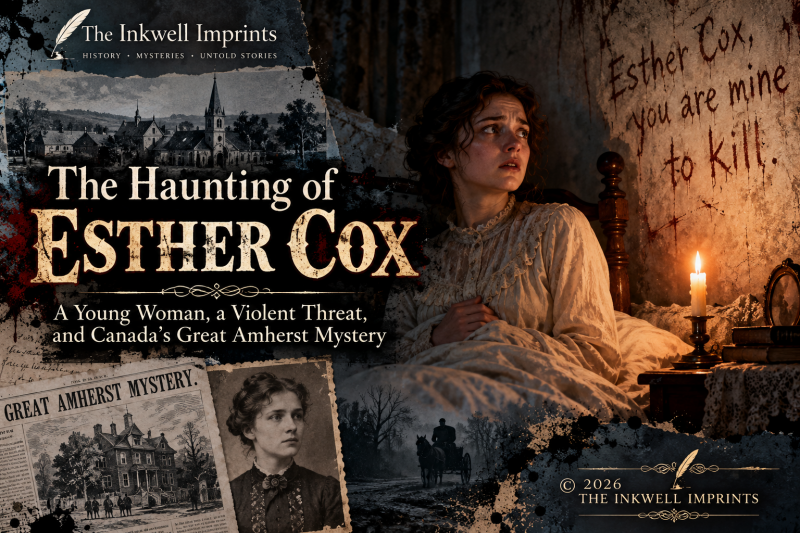
In 1878, an eighteen-year-old woman survived a terrifying encounter. What followed would become one of Canada’s most infamous alleged hauntings. But was Esther Cox tormented by something supernatural, or was there a darker, more human explanation?
By Yasmin Chaudhary | The Inkwell Imprints
A House That Would Not Remain Silent
Imagine lying in bed when an unexplained scratching begins beneath your mattress. You search for the source, expecting a mouse or perhaps something caught between the wooden boards. Nothing is there.
Then come the knocks.
At first, they are faint. Eventually, they grow so violent that the entire household can hear them. Furniture reportedly moves without anyone touching it. Objects fly across rooms. Fires appear without an obvious cause.
And then, perhaps most terrifying of all, a message appears on the wall:
“Esther Cox, you are mine to kill.”
This was the nightmare reportedly experienced by eighteen-year-old Esther Cox in Amherst, Nova Scotia, beginning in 1878.
The disturbances would attract journalists, investigators, physicians, and curious spectators. They would also transform an ordinary young woman into the center of a supernatural controversy that remains unresolved nearly 150 years later.
But before Esther Cox became associated with one of Canada’s most famous ghost stories, she was a young woman who had survived an act of violence.
And that part of her story deserves just as much attention.
Before the Haunting: A Terrifying Encounter
Esther Cox was born on March 28, 1860, in Upper Stewiacke, Nova Scotia. By 1878, she was living in Amherst with her older sister, Olive Teed, and Olive’s family.
In August of that year, Esther went riding with a young man identified in historical accounts as Bob MacNeil, whose surname also appears as McNeal.
According to accounts later documented by Walter Hubbell, the young man stopped their carriage in an isolated location and threatened Esther with a revolver.
The encounter has been described as an attempted sexual assault. Esther reportedly escaped when another carriage approached, interrupting the confrontation.
Although she survived physically, the experience was profoundly frightening.
Within weeks, strange events reportedly began inside the Teed household.
The timing raises a question that deserves careful consideration: could the disturbances have been connected in some way to the trauma Esther had endured?
Today, we understand that traumatic experiences can produce serious emotional and physical consequences. However, diagnosing Esther retrospectively would be speculative, and trauma itself does not establish an explanation for the alleged supernatural events.
What we can acknowledge is that Esther was a young survivor of violence whose suffering soon became a matter of public fascination.
The First Signs of Something Unexplained
The disturbances reportedly began in the bedroom Esther shared with her younger sister, Jennie.
The sisters initially believed an animal had found its way into their mattress. Strange scratching sounds interrupted their sleep, but searches revealed nothing.
Before long, the noises intensified.
Loud knocking and banging were heard throughout the home. Bedclothes allegedly moved on their own, and household objects appeared to shift without explanation.
Esther also experienced frightening physical symptoms.
Witness accounts described episodes of swelling, unusual bodily movements, and severe discomfort. Some observers believed her condition was being caused by an invisible presence.
As the weeks passed, the reported activity became increasingly aggressive.
Furniture tipped over. Objects were said to fly through the air. Esther complained of being struck, scratched, and pricked by unseen forces.
The household was no longer dealing with a few unexplained sounds.
According to those who believed the haunting was genuine, something appeared determined to terrorize Esther.
A Threat Written on the Wall
Among the most disturbing claims associated with the Great Amherst Mystery was the appearance of a threatening message.
Witnesses reported hearing what sounded like someone scratching or writing against a wall.
When they examined the surface, they allegedly discovered words threatening Esther’s life.
The message became one of the most widely repeated details of the case.
But what makes it particularly unsettling is its deeply personal nature.
The alleged presence did not merely announce itself. It singled out Esther and threatened to kill her.
Was the message evidence of an intelligent supernatural entity?
Was someone deliberately frightening the young woman?
Or could the threatening words have reflected a more complicated psychological or interpersonal situation?
There is no independently verified evidence establishing who created the message or how it appeared.
Nevertheless, the story spread rapidly, helping transform a local mystery into a national sensation.
When the Haunting Turned to Fire
The disturbances reportedly escalated beyond noises and moving furniture.
According to contemporary accounts, lighted matches appeared to fall from the ceiling, and unexplained fires broke out inside the Teed home.
For a family living in a nineteenth-century wooden house, fire represented a very real danger.
Whether the flames were deliberately set, accidentally ignited, or genuinely unexplained remains uncertain.
Reports also suggested that the alleged presence threatened to burn the house if Esther remained there.
Eventually, Esther stayed with other households, but the disturbances were said to follow her.
This became one of the defining characteristics of the Great Amherst Mystery.
Rather than being confined to a particular building, the alleged activity seemed centered on Esther herself.
That distinction fueled speculation that the case involved a poltergeist rather than a conventional haunting.
In paranormal folklore, poltergeists are commonly associated with loud noises, moving objects, and physical disturbances. Some theories also connect such reports to individuals experiencing significant emotional distress.
However, these interpretations remain theories, not scientifically established explanations for Esther’s experiences.
Walter Hubbell and the Making of a Famous Mystery
As reports spread, the case attracted the attention of Walter Hubbell, an American actor with an interest in supernatural phenomena.
Hubbell arranged to stay with the Teed family and investigate the disturbances.
He later claimed to have witnessed numerous extraordinary events, including moving objects, unexplained sounds, and physical attacks on Esther.
He also described communicating with supposed spirits through knocking sounds.
Hubbell eventually became convinced that the disturbances were genuine.
In 1879, he published The Haunted House: A True Ghost Story, presenting the events as evidence of supernatural activity.
His book helped make Esther Cox famous far beyond Amherst.
But Hubbell’s involvement also introduces an important question about credibility.
He was not simply an independent investigator. He was an entertainer and author whose account became commercially successful.
That does not automatically invalidate everything he reported, but it does mean his testimony should be examined critically.
The existence of witnesses establishes that people reported unusual events. It does not establish that ghosts caused them.
Furthermore, much of what modern readers know about the haunting comes through accounts shaped by the beliefs, expectations, and interests of those who told the story.
And Esther’s own perspective was often overshadowed.
From Frightened Young Woman to Public Entertainment
In June 1879, Esther accompanied Hubbell and businessman John White on a public tour intended to present the mystery to paying audiences.
People came hoping to witness the extraordinary phenomena they had read about.
But supernatural disturbances do not perform on command.
The tour reportedly ended after only two engagements in New Brunswick, following hostile reactions from disappointed spectators.
It is difficult not to consider how humiliating this experience may have been for Esther.
A young woman who had survived a frightening assault and subsequently become the subject of sensational claims was now being displayed before audiences expecting a supernatural spectacle.
When nothing happened, some apparently turned against her.
Whether Esther believed she was haunted, participated in deception, or experienced events she could not explain, the public’s fascination came at a personal cost.
The woman at the center of the story was becoming less important than the entertainment surrounding her.
The Barn Fire That Changed Everything
In late 1879, Esther’s circumstances took another dramatic turn.
While staying with another family, she became implicated in a barn fire.
Unlike the earlier unexplained fires, this incident resulted in criminal proceedings.
Esther was convicted of arson and sentenced to four months in jail.
According to the Dictionary of Canadian Biography, she was released after serving approximately one month, reportedly following public appeals on her behalf.
The alleged paranormal disturbances also came to an end around this period.
For skeptics, the conviction raised serious doubts about the haunting.
If Esther was responsible for the barn fire, could she also have caused some of the earlier disturbances?
It is a reasonable question, but the conviction does not prove that every event described in the Teed home was staged.
Likewise, the absence of further reported disturbances does not prove that a supernatural presence had departed.
The case remained open to interpretation.
Could Trauma Explain the Great Amherst Mystery?
One of the most overlooked aspects of Esther Cox’s story is the connection between the reported disturbances and the violence she experienced shortly before they began.
Psychological trauma can affect sleep, memory, emotional regulation, and physical well-being. Severe distress may also produce symptoms that are difficult for observers to interpret.
In the nineteenth century, understanding of psychological trauma was limited, particularly when it came to women who had experienced sexual violence.
Esther’s symptoms were interpreted within a society fascinated by spiritualism, ghosts, and supernatural communication.
Could some of her experiences have been misunderstood medical or psychological symptoms?
Possibly.
Could certain disturbances have been deliberately created, either by Esther or someone else?
That possibility cannot be dismissed.
Could witnesses have misinterpreted ordinary events or exaggerated what they observed?
Certainly.
None of these possibilities requires us to assume that Esther consciously fabricated her suffering.
And none can be conclusively established from the surviving evidence.
Later skeptical investigators, including Walter Franklin Prince, challenged the supernatural interpretation and examined the possibility of deception or dissociative behavior.
But Esther cannot be clinically evaluated more than a century after her death.
We should be cautious about replacing one unsupported certainty with another.
The Life Esther Lived Afterward
Despite the notoriety surrounding her, Esther eventually moved beyond the public controversy.
She married Adam Porter in 1882 and had a son. After that marriage, she later married Peter Shanahan in 1896.
She eventually settled in Brockton, Massachusetts, where she died on November 8, 1912, at the age of fifty-two.
No comparable series of disturbances is documented during her later years.
Yet the haunting continued to define how history remembered her.
Books, paranormal investigations, and retellings preserved the terrifying incidents, while the ordinary details of Esther’s life received comparatively little attention.
The Great Amherst Mystery became a legend.
Esther Cox became its central character.
And somewhere along the way, the distinction between the woman and the ghost story began to disappear.
A Mystery That Still Haunts Amherst
Nearly a century and a half after the original reports, the Great Amherst Mystery remains part of Nova Scotia’s paranormal heritage.
The story continues to inspire historical discussions, ghost tours, and local events, including Esther Fest in Amherst.
For believers, it represents one of Canada’s most compelling cases of alleged poltergeist activity.
For skeptics, it illustrates how sensational reporting, unreliable testimony, and human behavior can create a seemingly supernatural mystery.
Both interpretations reveal something about the society in which the events occurred.
The late nineteenth century was a period when spiritualism attracted widespread attention. Accounts of ghostly communication and mysterious physical manifestations found eager audiences.
Esther’s story emerged at precisely the right moment to become a sensation.
But popularity should never be mistaken for proof.
Who Was Really Haunting Esther Cox?
There is something deeply unsettling about the Great Amherst Mystery that has nothing to do with ghosts.
An eighteen-year-old woman survived a violent encounter. Soon afterward, she became the center of terrifying claims that strangers debated, investigated, published, and paid to witness.
Her body, her behavior, and her credibility were scrutinized.
Other people became authorities on what she had experienced.
And more than a century later, we are still asking whether Esther Cox was haunted, dishonest, or misunderstood.
Perhaps the more important question is whether anyone truly listened to her.
The historical evidence does not allow us to declare the haunting genuine. Nor does it permit us to explain every reported incident with certainty.
What it does reveal is a young woman whose life became entangled with fear, public spectacle, and competing interpretations of events that she herself may never have fully understood.
Whether the noises came from hidden human hands, mistaken perceptions, or something that remains unexplained, the consequences for Esther were real.
The most haunting part of Esther Cox’s story may not be what happened inside that house, but how easily the woman at the center of it was lost beneath the legend.
And perhaps that is the mystery we should remember.
Sources and Further Reading
- Diane Tye, Esther Cox (Porter; Shanahan), Dictionary of Canadian Biography, University of Toronto/Université Laval. https://www.biographi.ca/en/bio/cox_esther_14E.html
- Nicole Baker, The Great Amherst Mystery, 1888, U.S. National Library of Medicine, October 28, 2021. https://circulatingnow.nlm.nih.gov/2021/10/28/the-great-amherst-mystery-1888/
- Walter Hubbell, The Haunted House: A True Ghost Story (1879), historical firsthand account.
- Walter Franklin Prince, A Critical Study of the Great Amherst Mystery (1919), skeptical investigation.
- About the Great Amherst Mystery, Esther Fest, Amherst, Nova Scotia. https://greatamherstmystery.com/story-of-the-great-amherst-mystery/
Editor’s note: This article examines historical reports of alleged paranormal phenomena. Claims of supernatural activity are presented as reported accounts, not verified facts. Esther Cox’s experiences are discussed with consideration for the historical limitations of available testimony and records.
Add comment
Comments