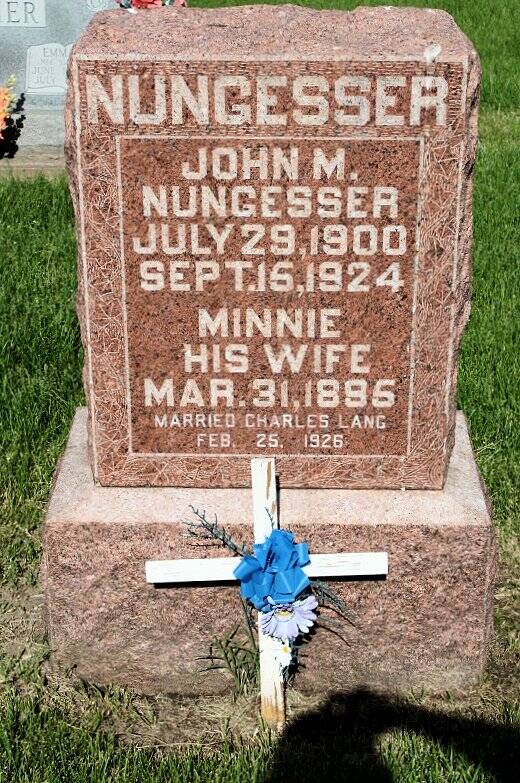
Source: FindAGrave.com
by Yasmin Chaudhary — The Inkwell Times
On September 15, 1924, John Nungesser finished a day of farm work near Highland, Illinois, and headed home in a wagon drawn by four horses. The 24-year-old farmer never reached his wife, Minnie. His body was found beside Mudge Road roughly half an hour after he had been seen leaving the field.
His murder led to the prosecution of three men: Emil Fricker, Eldo Wernli, and Jacob Landert. The case reached the Illinois Supreme Court as People v. Fricker, but Fricker was the defendant, not the murder victim.
Behind the legal arguments was a history of threats, sexual coercion, and the deaths of two men Minnie had married.
Minnie’s Connection to Fricker
Minnie Schlicht began working in Fricker’s household in 1910, when she was 15, as a domestic servant and dairy worker. Fricker was a married farmer and dairy businessman. The court’s account states that sexual relations between them began when Minnie was 19.
She later married Robert Kehrli, who was murdered shortly afterward. Minnie returned to Fricker’s household before marrying John Nungesser in October 1922.
The appellate opinion records that Fricker had already been convicted of Kehrli’s murder at the October 1924 term of the Madison County circuit court and sentenced to life imprisonment.
Minnie’s testimony in the Nungesser case described abuse. She said Fricker warned before her second marriage that he would kill any man she married. Afterward, she testified, he summoned her to collect money he owed her and forced her into sexual intercourse through a threat backed by a revolver. She also described another visit during which he refused to let her return home.
Fricker denied threatening or restraining her and denied continuing sexual relations after her marriage.
The opinion repeatedly uses the period’s language of “illicit relations.” That wording should not obscure Minnie’s account of force and confinement. Describing her testimony simply as an affair would erase the coercion she reported.
The Plot Against John Nungesser
According to the prosecution evidence summarized by the court, Fricker wanted Minnie back in his household and began planning her husband’s murder in early 1923.
Wernli was Fricker’s son-in-law, having married his daughter Orlene. Landert was a longtime intermittent farm employee. Both testified that Fricker directed the killing and that fear of him influenced their participation.
Earlier schemes failed. The plan ultimately carried out involved intercepting Nungesser on his journey home. Wernli would stop the horses and speak with him while Landert waited concealed nearby.
Their testimony described both men shooting Nungesser. Fricker, they said, supplied the weapons and instructions. All three men were arrested during the night following the killing.
Wernli and Landert pleaded guilty and received life sentences. Fricker was tried separately, convicted, and sentenced to death.
Why Minnie’s Testimony Mattered
Fricker’s appeal challenged the admission of Minnie’s testimony, arguing that it described separate offenses unrelated to the murder charge.
The Illinois Supreme Court rejected that argument. It held that her testimony was relevant to the prosecution’s explanation of motive: Fricker’s desire to continue sexual relations with Minnie supplied a reason for seeking her husband’s death. The fact that the evidence also described other criminal conduct did not make it inadmissible in this case.
Her testimony therefore formed part of the evidence explaining why Nungesser had been targeted.
The Appeal and Execution
The defense also challenged the refusal to move the trial to another county, remarks in the prosecutor’s closing argument, and the impartiality of the jury.
The court found that the showing of local prejudice did not justify a change of venue. It also rejected the challenges concerning the prosecutor’s remarks and a juror’s reported statement about imposing death if guilt and the evidence warranted it.
On February 18, 1926, the Illinois Supreme Court affirmed the judgment and directed that Fricker’s execution take place on April 16. The Madison County Historical Society records that he was hanged that day in Edwardsville—the county’s last hanging.
The People Behind the Case Name
The legal title preserves Fricker’s name. Remembering the case fully also means remembering John Nungesser and Robert Kehrli, both murdered, and Minnie, whose testimony described threats and sexual violence.
The record gives only a limited view of their lives. It nevertheless makes clear that this was more than a dispute over courtroom procedure: it was a case about deadly efforts to control a woman’s relationships and the men who were killed.
Historical note: The narrative draws primarily on the appellate opinion’s summary of trial evidence. Testimony, defense denials, and judicial rulings are identified separately; no private dialogue or thoughts have been invented.
Sources and Further Reading
- Illinois Supreme Court — People v. Fricker (1926): The court opinion summarizing trial testimony, the appeal, and the decision to uphold Fricker’s conviction and death sentence. Read the opinion.
- Madison County Historical Society — “Murder and Mayhem in Madison County” (May 2014): Historical coverage of the Fricker case and his execution on April 16, 1926. Read the newsletter.
Add comment
Comments