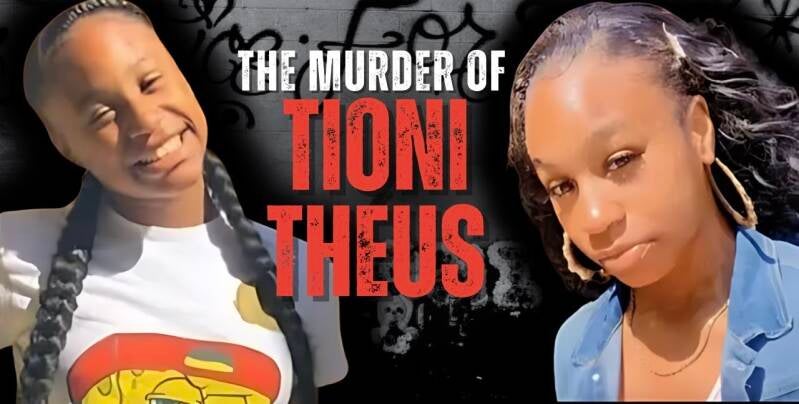
An investigative look at the life, death, unanswered questions, and continuing search for justice for Tioni Theus.
by Yasmin Chaudhary — The Inkwell Times
Content warning: This article discusses the murder of a child, gun violence, human trafficking/exploitation, and the circumstances surrounding the discovery of a teenager’s body.
On the morning of January 8, 2022, drivers traveling through South Los Angeles encountered something horrifying.
Along the Manchester Avenue on-ramp to the 110 Freeway, the body of a teenage girl lay beside the road.
She had been shot in the neck.
Her name was Tioni Theus.
She was 16 years old.
And more than four years later, the person—or people—responsible for her murder have still not been held accountable.
Tioni’s death was not simply another unsolved homicide. It was the killing of a child whose life had already been marked by profound trauma, instability and vulnerability. Her story also raised uncomfortable questions about how America responds when the victim is a Black girl, particularly one whose circumstances make it easier for the public to reduce her to labels rather than see the child underneath them.
Tioni was more than the circumstances surrounding her final night.
She was a daughter.
A cousin.
A student.
A golfer.
A dancer.
A teenager who loved music, family and being around the people she cared about.
And somebody’s little girl.
Her family has spent years asking the same question:
Who killed Tioni Theus?
Who Was Tioni Theus?
Tioni lived in Compton, California, and attended Centennial High School.
Family members described her as bright, energetic, funny and affectionate. She was reportedly a straight-A student who enjoyed golf, dance and music.
One of the most striking things about accounts of Tioni is the contrast between the girl her family remembered and the way her story was sometimes reduced after her death.
She was a teenager.
She was also a teenager who had experienced things no child should have had to endure.
When Tioni was around 13, her mother, Teresa, was seriously injured in a hit-and-run crash.
Tioni and a cousin were reportedly on their way to meet Teresa when they encountered the aftermath of the collision. Tioni recognized her mother’s purse and shoes and realized what had happened before the adults around her could fully process it.
Her mother survived, but suffered devastating physical and mental consequences.
Tioni’s family later described the experience as deeply traumatic for her. Her grandparents also died, leaving additional upheaval in a young girl’s life.
That history matters.
Not because trauma somehow explains or excuses what happened to Tioni—it does not—but because it helps explain how a bright young teenager could become increasingly vulnerable to adults and circumstances that her family feared were exploiting her.

January 7, 2022
The last known day of Tioni’s life began like an ordinary day.
At some point, she told her father that she was going to meet a friend and attend a party.
According to a later Los Angeles County Board of Supervisors document, she had reportedly been planning to meet an “Instagram friend.”
She left.
She never came home.
That seemingly ordinary detail became one of the most important pieces of the investigation.
Who was the friend?
Who was she meeting?
Where did Tioni go after leaving her father’s home?
And, most importantly:
Who was with her during the hours before she died?
The Discovery
At approximately 8 a.m. on January 8, motorists noticed Tioni’s body near the 110 Freeway’s Manchester Avenue on-ramp near South Figueroa Street.
She had suffered a fatal gunshot wound to the neck. The Los Angeles County Medical Examiner determined that the gunshot was the cause of death.
The location immediately raised questions.
Tioni hadn’t simply been killed in a private residence and left there.
Her body had been left beside one of Los Angeles’ busiest freeways.
Someone had placed—or abandoned—her there.
And whoever did it apparently believed they could get away.
The California Highway Patrol took the lead in the investigation, with assistance from the Los Angeles Police Department.
What Happened Between the Party and the Freeway?
This remains one of the central mysteries.
Tioni was last known to be heading out to meet someone.
The next morning, she was dead.
There is no publicly identified killer.
No publicly identified vehicle.
No publicly established motive.
And, despite years of investigation, authorities have not announced an arrest.
That lack of information makes it particularly difficult to reconstruct Tioni’s final hours with certainty.
It is important to distinguish documented facts from allegations and investigative theories.
There have been reports that Tioni became involved with people she met through social media, including older men. Family members told reporters that they believed a man she met on Instagram had drawn her into prostitution and theft.
Los Angeles County District Attorney George Gascón also said in January 2022 that investigators had evidence suggesting Tioni may have been a victim of human trafficking. He did not publicly provide the details supporting that assessment.
That distinction is crucial.
Tioni was never convicted of anything.
And being exploited, manipulated, trafficked or involved with dangerous people would never make her responsible for her own murder.
She was 16.
Adults who prey upon vulnerable children bear responsibility for their actions.
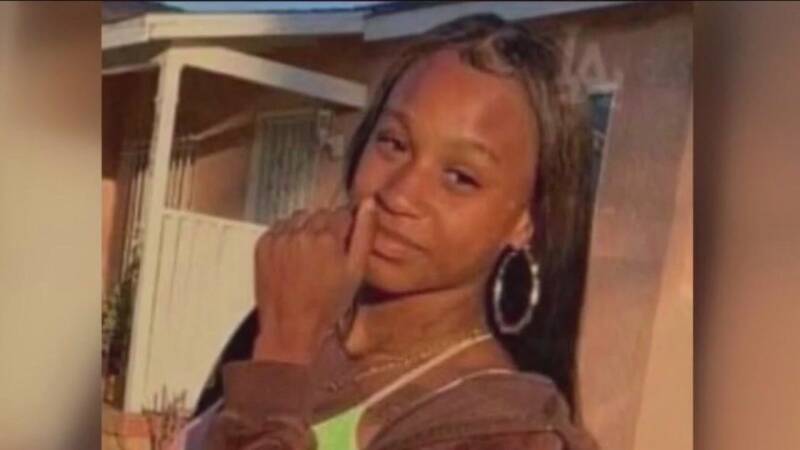
A Teenager Caught in a Dangerous World
Perhaps the most painful part of Tioni’s story is how easily a complicated teenager can disappear behind a label.
“Runaway.”
“Troubled.”
“Prostitute.”
“Bad crowd.”
Those words may describe fragments of someone’s circumstances, but they do not describe a human being.
Tioni’s cousin Nafeesah Kincy made precisely this point after the murder.
She acknowledged that Tioni had experienced difficulties but emphasized the need to humanize her, rather than allowing her to become defined by allegations about her lifestyle.
That is particularly important when discussing children who may have been sexually exploited.
A 16-year-old involved with adults who exploit minors is not an adult making an informed choice about her own exploitation.
She is a child in danger.
The Question of Human Trafficking
The trafficking theory remains one of the most significant—and least publicly explained—aspects of the investigation.
Authorities indicated there was evidence Tioni may have been trafficked, but investigators have never publicly laid out the entire evidentiary picture.
That leaves several unanswered questions:
- Who were the adults Tioni had been associating with?
- Who was the Instagram contact she intended to meet?
- Did she know the people responsible for her death?
- Was her murder connected to sexual exploitation?
- Was she killed because she attempted to leave an exploitative situation?
- Was her death connected to another crime?
- Did someone know where she would be that night?
- Was she transported to the freeway after being killed elsewhere?
At present, the public does not have enough verified information to answer those questions.
And that’s where responsible true-crime reporting has to stop short of speculation.
There is a difference between asking investigative questions and declaring an unproven theory to be fact.
Why Was Tioni’s Case So Easily Forgotten?
This question became impossible to ignore when Tioni’s murder was compared with another Los Angeles homicide occurring just days later.
On January 13, 2022, 24-year-old UCLA graduate student Brianna Kupfer was murdered while working alone at a furniture store in Hancock Park.
Her case received enormous media attention.
A suspect was quickly identified and arrested.
A $250,000 reward was offered.
Tioni’s family watched from the sidelines.
Their daughter had been murdered just days earlier, yet her case appeared to receive dramatically less attention.
The contrast became the subject of a Los Angeles Times column by Erika D. Smith, which explicitly questioned why Tioni’s case had received so little attention compared with Kupfer’s.
The comparison sparked a broader conversation about “missing white woman syndrome” and disparities in media attention given to victims of different races.
A later City of Los Angeles report examining violence against Black women documented the disparity in reward funding.
Tioni’s reward eventually reached $120,000 over approximately four months.
Kupfer’s reached $250,000 in less than a month.
The report specifically recommended that the city examine its reward system to ensure offers are made more equitably.
That doesn’t mean Brianna deserved less attention.
She deserved justice.
Tioni did too.
The problem isn’t that one murdered woman received attention.
The problem is that another murdered girl didn’t receive enough.
The Search for a Killer
In the early weeks after Tioni’s death, authorities appealed publicly for information.
California Gov. Gavin Newsom authorized a $50,000 reward in January 2022 after the CHP reported that it had exhausted its investigative leads and requested the reward to encourage people with information to come forward.
Los Angeles and Los Angeles County subsequently contributed additional money.
By April 2022, the combined reward had reached $120,000.
But money doesn’t automatically produce answers.
Someone still has to know something.
Someone has to decide to speak.
Someone has to tell investigators what they saw, what they heard or what they know about Tioni’s final hours.
And investigators have had to live with the possibility that the person who knows the answer may have remained silent for years.
2023: Still No Answers
One year after Tioni’s murder, the case remained unsolved.
FOX 11 reported in January 2023 that her family and investigators were still searching for those responsible.
Golf Digest also revisited Tioni’s story more than a year after her death, emphasizing something that can easily be lost in crime reporting:
Tioni was a golfer.
She wasn’t simply a homicide statistic.
She was a teenage girl standing on a driving range with golf clubs, learning a sport and imagining a future.
That image is important because it forces us to confront the life that was taken—not merely the manner in which it ended.
2024 and 2025: A Case That Refused to Disappear
Tioni’s name continued to circulate through podcasts, documentaries and true-crime discussions.
But public attention did not translate into an arrest.
A 2024 podcast episode revisited the case and again identified it as unsolved, directing anyone with information toward the CHP.
In 2025, Black Girl Gone revisited Tioni’s story under the blunt title “STILL UNSOLVED.”
The description was painfully simple: when the case was originally covered, there were no answers.
Years later, there still weren’t.
2026: California Gives the Case Another Push
Then came an important development.
On April 24, 2026, Gov. Gavin Newsom announced that California was reissuing $50,000 rewards in a group of cold cases, including Tioni Theus’s murder.
The governor’s office listed Tioni specifically among the cases receiving renewed reward attention.
The state again directed anyone with information about her death to contact the California Highway Patrol.
This does not mean the case has been solved.
It does not mean a suspect has been publicly identified.
It does not mean investigators have announced a breakthrough.
But it does mean Tioni’s case remains officially recognized as an unresolved homicide—and that authorities are still seeking information that could lead to whoever killed her.
As of August 2026, there has been no publicly announced arrest or conviction in Tioni Theus’s murder.
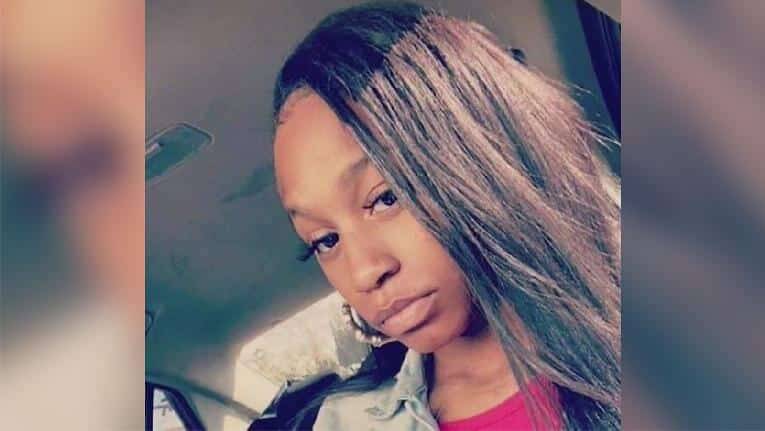
What We Know
After more than four years, the established facts remain remarkably stark:
Tioni Theus was 16.
She lived in Compton and attended Centennial High School.
She was described by family as an intelligent and vibrant young woman who enjoyed golf, dance and music.
She left home on January 7, 2022, reportedly intending to meet a friend and go to a party.
The following morning, her body was discovered beside the 110 Freeway.
She had been fatally shot in the neck.
The CHP investigated with assistance from the LAPD.
Authorities publicly raised the possibility that she had been a victim of human trafficking.
No killer has been publicly identified.
No one has been arrested or convicted for her murder.
And the investigation remains unresolved.
What We Don’t Know
And this is where Tioni’s story becomes a true mystery.
We don’t know precisely what happened during her final hours.
We don’t know who she was with.
We don’t know who transported her to the freeway.
We don’t know where she was killed.
We don’t know whether trafficking played a direct role in her death.
We don’t know whether her killer was someone she knew.
We don’t know whether someone witnessed her death.
And we don’t know why, after all these years, no one has come forward with the information necessary to solve it.
Those unanswered questions are not invitations to invent answers.
They’re reminders that someone knows something.
A Child Should Not Become a Cold Case
Perhaps the most troubling part of Tioni’s story is not simply that her killer remains free.
It’s how quickly the world can become accustomed to that fact.
Four years becomes five.
A teenager becomes a photograph.
A photograph becomes a hashtag.
A hashtag becomes an old case.
And eventually, people stop remembering that there was once a 16-year-old girl who had an entire life ahead of her.
Tioni should have been worrying about school.
Friends.
Music.
Golf.
Growing up.
Maybe college.
Maybe love.
Maybe becoming a mother herself someday.
Maybe a career nobody could have predicted.
She should have had the chance to become whoever she was going to become.
Instead, her family received the unimaginable news that their child had been found dead beside a freeway.
And they have spent years without the most basic thing families of murder victims deserve:
answers.
Justice for Tioni
Tioni’s case is a reminder that justice cannot depend on whether a victim had a perfect life.
Children don’t need to be perfect to deserve protection.
Teenagers don’t need to make perfect decisions to deserve to come home.
And victims don’t need to have lived lives free of trauma, mistakes or bad influences to deserve justice after someone kills them.
Tioni was 16.
Whatever happened in the months leading up to her death, someone murdered her.
That is the fact that should remain at the center of this story.
The question isn’t whether Tioni was perfect.
The question is:
Who killed her?
And perhaps more importantly:
Who knows?
If You Know Something
The California Highway Patrol continues to seek information regarding Tioni Theus’s murder.
The CHP has publicly listed 323-644-9550 as a contact number for information about her case.
Even information that seems insignificant can potentially matter in a cold case.
A name.
A vehicle.
A social-media account.
A conversation.
A location.
Something someone saw that night.
Four years later, Tioni’s family is still waiting.
And Tioni’s name is still worth saying.
Tioni Theus.
Not “the girl found beside the freeway.”
Not “the troubled teenager.”
Not “the possible trafficking victim.”
Not a statistic.
Tioni.
A 16-year-old girl whose life mattered—and whose murder still deserves to be solved.
Add comment
Comments
I’m sorry but why none of her family members took time to support her after her brother & mother were basically deleted from her life??? Great-uncle, Dad, Aunt everybody has time to be outrage when it's too late 😞 We got to do better to our youth R.I.P. Thioni
She went thru so much in her short life, so her “rebelling” kind of made sense. HOWEVER, she did NOT deserve to die and be left on the side of the road! That's sickening! 😢
Let this be a lesson. When you see kids acting out, being “hot” and “fast”, instead of making them an outcast, before labeling, stop and get to know their story.
Why do they always resort to calling a young Black girl “fast”? Not to mention that after 4 years no one was found responsible?!
She was such a beautiful girl. RIP