
by Yasmin Chaudhary — The Inkwell Times
If there was one moment that transformed an already troubling case into national news, it was the discovery of a series of Craigslist advertisements.
By the time investigators encountered them, the allegations against Michelle Hadley had grown far beyond those of an angry former fiancée. What had begun as reports of unwanted emails and online harassment now appeared to involve something far more sinister.
The advertisements invited strangers to participate in violent sexual fantasies at the home of Angela Diaz.
According to investigators at the time, the posts described a “rape fantasy” scenario in which men were encouraged to ignore resistance because it was supposedly part of the role-play. Some ads included personal details that made them appear authentic, while others directed respondents to Angela’s residence. In several instances, unfamiliar men reportedly arrived at the home believing they had been invited there.
To law enforcement, the situation was alarming.
The possibility that someone was intentionally sending strangers to a private residence represented an escalation from harassment into conduct that could have resulted in serious physical harm.
The obvious question became: Who was responsible?
A Campaign That Appeared to Escalate
The Craigslist advertisements were only one piece of a growing collection of evidence.
Angela Diaz also reported receiving threatening emails. The messages became increasingly disturbing, describing violence, revenge, and death. She claimed someone wanted to destroy her marriage and terrorize her family.
Investigators believed they were watching a campaign become progressively more dangerous.
As the digital evidence accumulated, authorities began connecting seemingly separate incidents into one narrative.
Anonymous emails.
Fake online identities.
Craigslist advertisements.
Threatening communications.
Each new incident appeared to reinforce the last.
Rather than questioning whether the incidents were connected at all, investigators increasingly viewed them as evidence of a single suspect becoming more desperate and more dangerous.
That suspect was Michelle Hadley.
The Theory That Made Sense
From an investigative standpoint, the theory was understandable.
Michelle had previously been engaged to Ian Diaz.
Ian had moved on and married Angela.
A contentious breakup had already occurred.
Property disputes had complicated the separation.
To detectives, motive appeared obvious.
Former partners do sometimes stalk, threaten, or harass those they believe replaced them. Law enforcement agencies across the United States investigate thousands of legitimate stalking complaints every year.
Against that backdrop, Michelle fit a profile investigators recognized.
But profiles are not proof.
A person matching a familiar pattern does not automatically become the perpetrator.
When Circumstantial Evidence Becomes Convincing
One of the challenges in modern criminal investigations is that digital evidence can feel definitive.
An email exists.
A message is sent.
An account is created.
A post appears online.
Unlike eyewitness testimony, digital records often give the impression of certainty.
Yet computers only record activity—they do not necessarily identify the true person behind a keyboard.
Emails can be spoofed.
Accounts can be created under another person’s name.
Internet traffic can be disguised.
Public Wi-Fi, VPNs, and anonymous services can complicate attribution.
Cybercrime investigators are trained to distinguish between digital artifacts and proof of authorship because one does not automatically establish the other.
That distinction would become critically important in Michelle Hadley’s case.
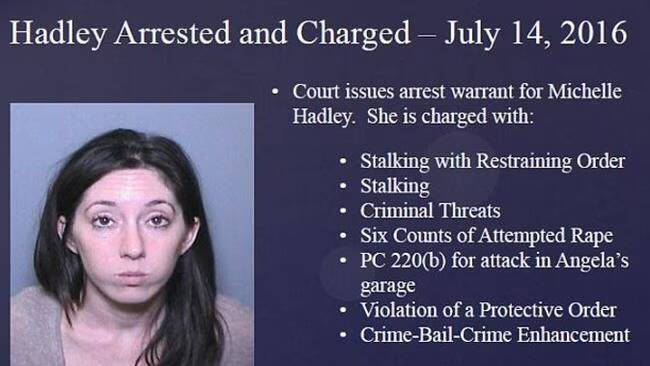
Michelle’s Arrest
By October 2016, investigators believed they had enough evidence to act.
Michelle Hadley was arrested and charged with multiple felony offenses, including stalking, criminal threats, and solicitation-related charges stemming from the Craigslist advertisements.
The allegations were staggering.
Media coverage quickly portrayed the case as another example of an obsessed former lover refusing to let go.
For Michelle, the arrest was life-altering.
She maintained that she was innocent.
She insisted someone else had created the emails.
She denied writing the Craigslist advertisements.
She repeatedly told investigators she was being framed.
Those denials, however, were overshadowed by what appeared to be a mountain of digital evidence.
She was booked into jail with bail set at $1 million, where she would remain for approximately 88 days awaiting developments in a case that seemed overwhelmingly stacked against her.
Outside the courtroom, public opinion had already begun to form.
To many observers, the case looked solved.
A Story Too Perfect
Looking back, one aspect of the investigation stands out.
Everything appeared to fit.
The motive.
The timeline.
The digital evidence.
The emotional context.
The victim’s account.
When every piece of evidence points neatly in one direction, investigators naturally become more confident in their conclusions.
Yet experienced investigators also recognize another possibility.
Sometimes evidence that appears too perfect deserves additional scrutiny.
As later court proceedings would reveal, that possibility was about to change everything.
The First Cracks
Even as Michelle remained behind bars, questions quietly began emerging.
Digital records did not always align with witness statements.
Some online activity seemed inconsistent.
Investigators started uncovering information that raised doubts about how the evidence had been created—and who had actually created it.
The case that once appeared airtight was beginning to fracture.
Those fractures would eventually expose one of the most elaborate false accusation schemes California prosecutors had ever encountered.
But first, investigators would have to confront a difficult possibility:
What if the victim they believed they were protecting had been manipulating the investigation from the beginning?
Coming in Part IV
The Lies Unravel: How Investigators Discovered the Truth
In Part IV, we’ll examine the evidence that dismantled the prosecution’s case against Michelle Hadley. From fabricated pregnancies and forged medical records to forensic digital evidence and the eventual convictions of Angela and Ian Diaz, we’ll explore how investigators uncovered the truth—and why the consequences of this conspiracy continue to resonate nearly a decade later.
Add comment
Comments
I like how you made it into different parts. I can't believe that Michelle had to go through this and I feel like Angela is being abused by Ian too.