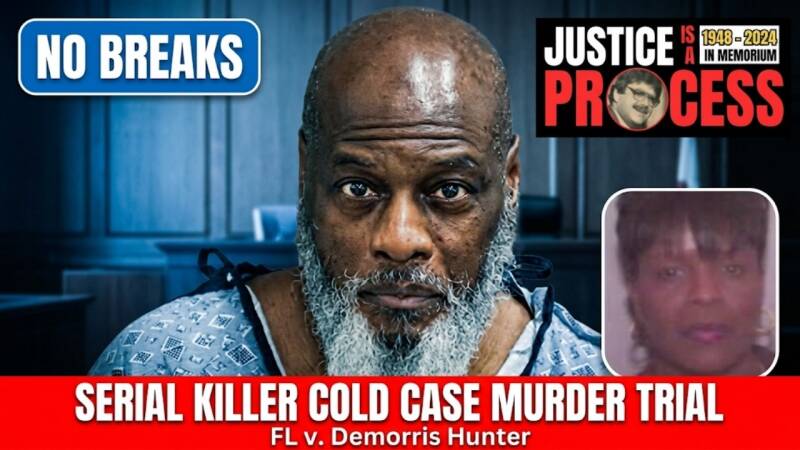
An Investigative Article by The Inkwell Times
When people hear the name Demorris Hunter, they often think of courtrooms, convictions, and headlines describing a serial killer who evaded justice for years. But focusing solely on the man responsible risks repeating a familiar mistake in true crime: allowing the perpetrator to eclipse the people whose futures were stolen.
Behind every case file was a person with relationships, dreams, routines, and a life that mattered long before it intersected with violence.
This is their story.
A Pattern Hidden Across Two States
Hunter’s known murders stretched from California to Florida across nearly two decades. His crimes were separated by years, different victims, and different jurisdictions, making it difficult for investigators to recognize a pattern immediately.
By the time authorities connected the cases, three people had lost their lives, another man had been permanently disabled, and countless family members had spent years searching for answers.
Cesar Guzman
Only 18 Years Old
In January 1985, eighteen-year-old Cesar Guzman was shot and killed in Oakland, California.
He had barely entered adulthood.
Unlike many notorious homicide victims whose lives become public record, relatively little has been preserved about Guzman’s personal story. That absence is heartbreaking in itself. His life became summarized in legal documents instead of memories shared with the world.
Every murder victim deserves to be remembered as more than the first entry on someone’s criminal timeline.
For Hunter, Guzman became his first known homicide.
For Guzman’s family, it was the beginning of a lifetime without him.
The Forgotten Survivor
Not every victim dies.
Just weeks after Guzman’s murder, Hunter shot Eric Wright, leaving him paralyzed.
Wright survived the attack but later died in 1986 from complications related to his injuries. His death illustrates an often-overlooked reality: homicide statistics rarely capture those whose lives are permanently altered before ultimately succumbing to their wounds.
Another shooting victim, Adolphus Williams, survived after Hunter fired a sawed-off shotgun at him.
Survivors of violent crime often disappear from public discussion, yet they carry physical and emotional scars long after headlines fade.
Ivora Denise Huntley
A Woman Who Tried to Help
Seventeen years after his first known murder, Hunter killed again.
On May 17, 2002, Ivora Denise Huntley, 41, encountered what appeared to be a domestic assault in Oakland.
Rather than looking away, she intervened.
According to prosecutors, Hunter responded by shooting her.
There is something profoundly tragic about Huntley’s final act.
She appears to have stepped forward because another human being seemed to need help.
That instinct—to protect someone else—is often what communities celebrate as courage.
Instead, it cost her everything.
Theresa Ann Green
A Cold Case That Waited Decades
Only days after Huntley’s murder, Hunter fled California.
He arrived in Orlando, Florida.
There, 38-year-old Theresa Ann Green crossed his path.
Green lived in the same apartment complex and reportedly knew Hunter socially. On the night she disappeared, witnesses placed them together after a gathering with neighbors.
She never came home.
Investigators eventually found Green’s body inside the trunk of her own vehicle in a Walgreens parking lot. She had been strangled. Her car had been abandoned in an apparent effort to distance the killer from the crime.
For years, her family waited.
Evidence accumulated slowly.
Witness statements evolved.
The investigation endured delays caused by extradition issues, legal proceedings, and the COVID-19 pandemic before finally reaching trial in 2026.
Justice delayed does not erase grief.
It simply asks families to carry it longer.
The Cost Beyond the Headlines
Hunter’s story is sometimes presented as one about parole failures, interstate investigations, or courtroom drama.
Those are important discussions.
But they should never overshadow what was actually lost.
Three families buried loved ones.
One family watched a survivor become permanently disabled before eventually losing him.
Friends lost lifelong companions.
Communities lost neighbors.
Every birthday that passes…
Every holiday with an empty chair…
Every photograph that suddenly becomes irreplaceable…
Those are the lasting consequences of serial murder.
Why Victim-Centered Storytelling Matters
True crime has changed dramatically over the past decade.
Audiences increasingly ask an important question:
Who were the victims before they became victims?
The answer matters because violence should never become entertainment detached from humanity.
Remembering Cesar Guzman, Eric Wright, Ivora Huntley, and Theresa Green reminds us that these were not simply names listed in court documents. They were people whose stories deserved far more pages than the man who ended them.
Hunter’s convictions may close legal chapters, but they cannot restore birthdays missed, conversations unfinished, or futures erased.
The most enduring legacy of this case should not be the notoriety of a serial killer.
It should be the memory of the lives he stole.
Add comment
Comments
I can't believe being so evil as to want to murder someone.