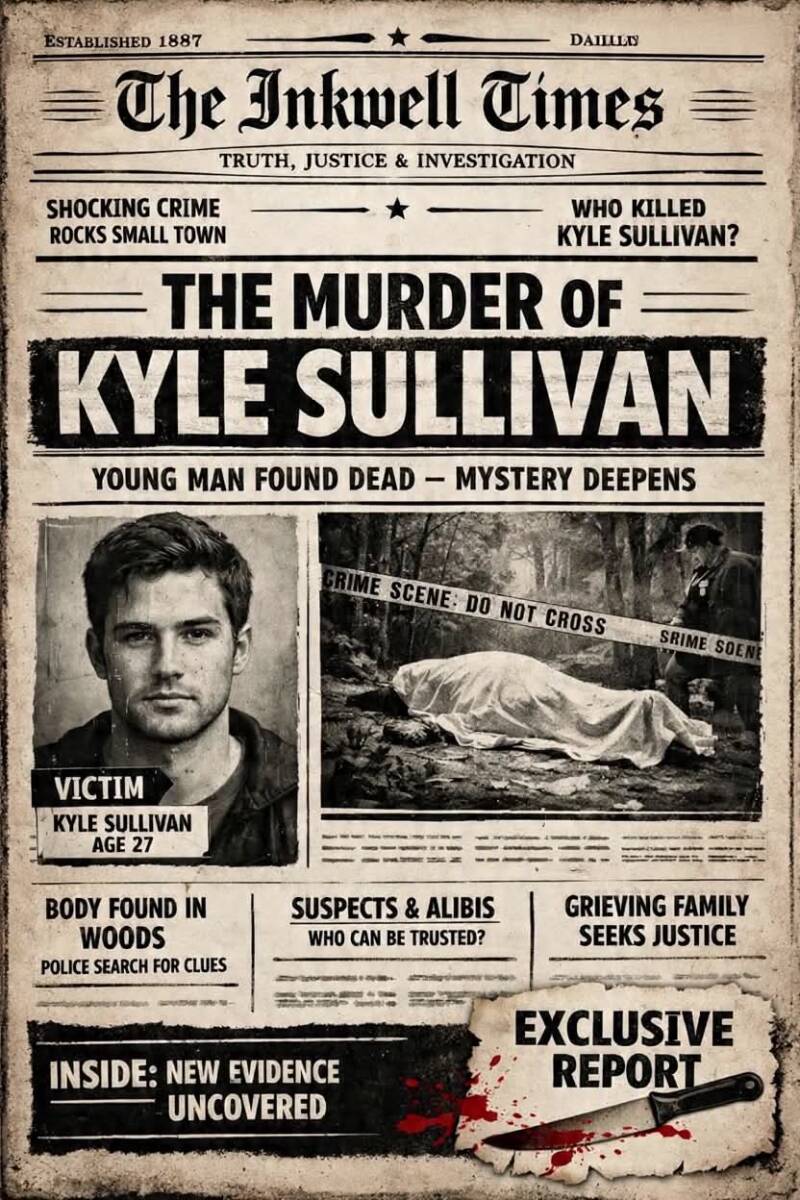
by Yasmin Chaudhary — The Inkwell Times
He Wasn’t the Target. He Was Simply There.
On a spring night in Colorado Springs, 29-year-old Kyle Scott Sullivan was inside a home on North 7th Street.
He was house-sitting for friends.
He had no reason to believe that anyone was coming for him.
He didn’t know the men who would enter the home.
He didn’t know that the house had become the target of a burglary.
And he certainly couldn’t have known that being in that house would cost him his life.
Kyle—known affectionately to friends as “Sully”—was murdered during a violent home invasion in April 2016.
What began as an attempted burglary became a killing.
And Kyle, who had never met the men responsible, became the victim.
Who Was Kyle Sullivan?
Before he became the subject of a homicide investigation, Kyle was simply Kyle.
To his friends, he was the kind of person who made connections everywhere he went.
Friends described him as caring, optimistic and deeply concerned about other people.
One of the things Kyle reportedly wanted to accomplish was ending homelessness. He had even written down his goal in a handwritten note he showed to friends.
He wasn’t interested in simply making money for himself.
Friends said he wanted to make money so that he could give it away.
He had moved to Colorado Springs in the fall of 2015 with dreams of building a new life. Among those dreams was eventually purchasing 36 acres of land and opening a marijuana dispensary.
He played guitar.
He wrote poetry and turned it into songs.
He made wire-wrapped jewelry and hat pins for friends.
He had plans.
He had ideas.
He had a future.
And then someone else’s greed interrupted all of it.
April 2016
Kyle was staying at a home in the 200 block of North 7th Street in Colorado Springs while his roommates were away.
According to investigators and later court testimony, two men had learned through Facebook that the home’s occupants were out of town.
They believed the house was empty.
They were allegedly planning to steal marijuana from a grow operation in the basement.
The men were Michael Anthony Durante and Daniel Alan Newell.
Both were former Fort Carson soldiers who had served together in Iraq.
Kyle had never met either of them.
That distinction matters.
This wasn’t a dispute between enemies.
It wasn’t a revenge killing.
It wasn’t a confrontation between people with a history.
Kyle was simply in a house that two men believed would be empty.
The Home Invasion
The exact timeline of the killing was initially unclear, but prosecutors eventually presented a disturbing account of what happened.
Durante and Newell entered the home expecting to find nobody there.
Instead, they encountered Kyle.
He was asleep or in his bedroom when the men came inside.
Kyle woke up.
A confrontation followed.
According to testimony presented during the case, Durante struck Kyle with a baseball bat, knocking him unconscious.
Newell then used a knife to cut Kyle’s throat.
The attack was brutal.
Kyle died inside the home.
The men then ransacked the property.
They took various items, including cash, electronics and other property.
But the marijuana they had allegedly come looking for remained locked in the basement.
They had entered the house looking for something they believed was worth stealing.
Instead, they left behind a dead man.
Two Days of Silence
Kyle’s body wasn’t discovered immediately.
A neighbor found him two days later.
He had been killed inside the home where he had been staying.
Early reports described Kyle as the first homicide victim of 2016 in El Paso County.
At first, investigators were looking for answers.
Who had entered the house?
Why was Kyle killed?
Who knew the occupants were away?
And who could have known about the marijuana operation?
The investigation eventually led police to Daniel Newell.
But getting there would take weeks.
The Suspects
On May 4, nearly three weeks after Kyle’s death, Colorado Springs police announced that they had identified Newell as a suspect in the murder.
He was considered dangerous.
Police believed he had ties to New Mexico and California.
Then Newell fled.
On May 12, he was arrested in Stockton, California.
He was initially wanted on suspicion of first-degree murder.
But investigators weren’t finished.
Another name emerged:
Michael Anthony Durante.
Durante had served alongside Newell in Iraq.
He was arrested in July 2016.
Both men were eventually charged with first-degree murder and burglary.
The Woman Who Helped Break the Case Open
One of the most significant witnesses was Jamie Ann Reinesto, Newell’s former girlfriend.
Reinesto was not present during the killing.
But she testified that Newell and Durante had told her about the crime afterward.
She said the men had entered the house believing it was empty because its occupants were on vacation.
She also testified about what happened when Kyle confronted them.
According to her account, Durante struck Kyle with a baseball bat.
Newell then cut his throat.
Reinesto herself became entangled in the investigation because stolen property from the home had allegedly been pawned.
She was offered immunity for information provided in her testimony, along with a deferred sentence on certain charges.
That arrangement became a major point of attack for the defense.
Attorneys argued that Reinesto had an incentive to shape her story to protect herself.
Prosecutors, however, argued that her testimony fit with other evidence in the case.
A Murder With Little Physical Evidence
The trial of Michael Durante would eventually turn on a difficult question:
Was he actually responsible for Kyle’s death, or was he simply associated with the man who committed it?
The defense emphasized the lack of DNA and fingerprints tying Durante directly to the crime.
Prosecutors acknowledged that physical evidence wasn’t the heart of their case.
Instead, they relied heavily on relationships, communications and testimony.
As one prosecutor put it during opening statements, the case wasn’t going to be solved by DNA or fingerprints.
It was about relationships.
Durante knew someone connected to the house.
He had information about when the occupants would be away.
He and Newell had served together.
And prosecutors argued that those connections placed him directly inside the conspiracy to burglarize the home.
Daniel Newell Takes a Plea
In January 2017, Newell pleaded guilty to second-degree murder and first-degree burglary.
In exchange, prosecutors dismissed the more serious first-degree murder charge.
He admitted responsibility for killing Kyle.
The plea agreement called for a sentence between 45 and 60 years.
At his sentencing, prosecutors argued for the maximum.
They pointed out that Newell had fled to California after the killing and emphasized the brutality of the attack.
The judge ultimately sentenced him to 62 years in prison: 48 years for second-degree murder, 12 years for first-degree robbery and two additional years for possessing a weapon in jail.
The first man responsible for Kyle’s death had now been sentenced.
But the case against Durante was still heading toward trial.
The Trial of Michael Durante
Durante’s trial began in February 2017.
Prosecutors argued that he had helped plan the burglary and that he was directly involved in the attack on Kyle.
The defense disputed that account.
They argued that the evidence against Durante was largely based on witnesses whose credibility could be questioned.
There was no DNA tying him to the killing.
There were no fingerprints.
The defense argued that the prosecution was asking jurors to rely on testimony from people who had their own reasons for cooperating with authorities.
But prosecutors presented a different picture.
They argued that Durante had information about the home, participated in the burglary and was physically involved in the attack that left Kyle unconscious before Newell killed him.
The jury ultimately sided with the prosecution.
Guilty
On February 23, 2017—what would have been Kyle’s 30th birthday—a jury found Michael Durante guilty.
He was convicted of first-degree murder, felony first-degree murder and first-degree burglary.
The judge sentenced him to life in prison without the possibility of parole, along with a 32-year sentence to run concurrently.
The judge noted the terrible reality behind the crime:
Kyle had died over a relatively small amount of money and property.
His life had been reduced to an obstacle standing between two men and something they wanted to steal.
Kyle’s mother was present throughout the trial.
After the verdict, she said she believed justice had been served.
But justice could not give her son back.
The Part That Should Never Be Forgotten
It would be easy to let Kyle’s story become another crime statistic.
A burglary.
A marijuana grow.
Two former soldiers.
A baseball bat.
A knife.
A trial.
Two convictions.
But Kyle was much more than the circumstances of his death.
His friends remembered someone who wanted to make the world better.
Someone who wanted to help people experiencing homelessness.
Someone who could meet a stranger and treat them like a friend.
Someone who gave a shirt off his back to a person who was cold.
Someone who played music, wrote poetry and made things with his hands.
His friend Trent Knox said Kyle wanted to “save the world.”
That was the person who was lost.
A Life Interrupted
Kyle was 29.
He had already lived enough life to have dreams, friendships and experiences behind him.
But he was still young enough to be imagining everything that could come next.
He had moved across the country.
He was trying to build something.
He had plans for land.
Plans for a business.
Plans to help people.
And then, according to prosecutors, two men decided that a house they believed was empty was worth breaking into.
Kyle happened to be there.
That was enough.
There is something particularly cruel about that.
Kyle didn’t have to know his killers.
He didn’t have to have enemies.
He didn’t have to be involved in their lives.
He simply had to be in the wrong house at the wrong moment.
What Kyle’s Murder Says About Victims
True crime often focuses heavily on perpetrators.
Their histories.
Their motives.
Their relationships.
Their trials.
Their sentences.
But sometimes the most important question is much simpler:
Who was the person they took from the world?
Kyle Sullivan was a person who wanted to help others.
He was a son.
A friend.
A musician.
A creative person.
A dreamer.
A man who believed his life could be used to make someone else’s life better.
He didn’t know the men who killed him.
He never had a chance to understand why they had decided that whatever they wanted was worth risking another person’s life.
And he never got the chance to finish the life he had started building in Colorado.
Justice Came. But So Did the Loss.
Michael Durante will spend the rest of his life in prison without parole.
Daniel Newell received a decades-long sentence after admitting his role in Kyle’s murder.
The legal case is over.
But for Kyle’s family, there is no verdict that makes April 2016 disappear.
No sentence gives a mother back her son.
No conviction restores the future Kyle should have had.
And no courtroom can return the years that were stolen from him.
Kyle’s death was not inevitable.
It was the consequence of a decision made by other people.
Two men entered a home intending to steal.
Kyle was there.
And within minutes, a 29-year-old man who wanted to make the world better was fighting for his life.
He lost that fight.
But his life should never be reduced to the way it ended.
Kyle Sullivan was not a marijuana grower.
He was not a burglary victim.
He was not a name in a court file.
He was Sully.
He was a son.
He was a friend.
He was a person with plans.
And he deserved to live long enough to see them become reality.
Add comment
Comments
This one really got to me. The fact that Kyle wasn’t even supposed to be involved and was just in the wrong place at the wrong time is heartbreaking. He deserved so much more time. 🖤
I had never heard of Kyle before reading this. It’s so sad that his whole life can get reduced to the way he died. He sounded like such a caring and creative person. I’m glad you focused on him and not just the people who killed him.
Este foi um caso tão de partir o coração para ler. Eu nunca tinha ouvido falar de Kyle Sullivan antes de ler sobre isso, e toda a situação é simplesmente trágica, especialmente sabendo que ele nem deveria estar lá naquela noite. Quanto mais eu lia, mais perturbador o caso se tornava. Eu realmente apreciei como este artigo focou em Kyle como pessoa, e não apenas nas circunstâncias de seu assassinato. Uma história tão triste, e definitivamente uma que permaneceu comigo depois que terminei de ler.
I don’t even know what to say after reading this. I had to stop for a minute because Kyle’s story really got to me. The fact that he was never even supposed to be there makes it so much harder to process. He was just there, living his life, and ended up losing everything because of someone else’s actions. I kept thinking about how his family must feel knowing that he should still be here. This was honestly heartbreaking to read.