By Yasmin Chaudhary — The Inkwell Times
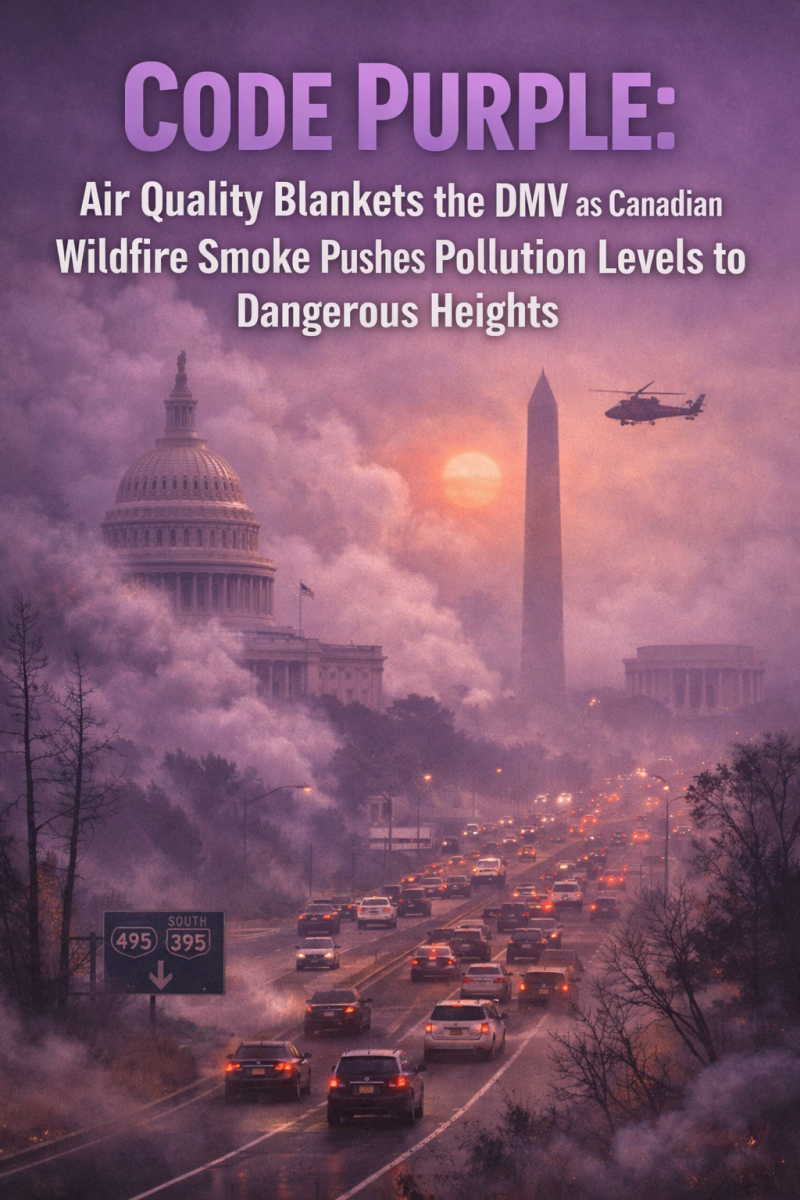
Residents across the Washington, D.C., Maryland, and Virginia (DMV) region are being urged to limit outdoor activity as air quality levels have reached Code Purple, a classification meaning the air is “very unhealthy” for everyone.
The dangerous air conditions are being caused by thick wildfire smoke traveling hundreds of miles south from Canada, where hundreds of wildfires continue to burn across provinces including Manitoba, Saskatchewan, and Ontario. Changing weather patterns have carried smoke into the eastern United States, creating hazy skies, reduced visibility, and elevated pollution levels throughout much of the region.
The DMV — including Washington, D.C., Northern Virginia, and parts of Maryland — has experienced worsening air quality throughout the week as new waves of wildfire smoke moved into the area.
What Does Code Purple Mean?
The Air Quality Index (AQI) is a measurement used to show how polluted the air is and how it may affect public health.
AQI levels are categorized as follows:
- 0–50: Good — Air quality is considered healthy.
- 51–100: Moderate — Air quality is acceptable, though some sensitive individuals may experience mild effects.
- 101–150: Unhealthy for Sensitive Groups (Code Orange) — Children, older adults, and people with heart or lung conditions may be affected.
- 151–200: Unhealthy (Code Red) — Everyone may begin experiencing health effects.
- 201–300: Very Unhealthy (Code Purple) — Everyone is at increased risk, and outdoor activity should be limited.
- 301 and above: Hazardous (Code Maroon) — Health risks are considered severe.
When the AQI reaches Code Purple, officials recommend that residents avoid prolonged outdoor exposure and move physical activities indoors.
Why Is the Air Quality So Poor?
The primary concern is PM2.5, or fine particulate matter found in wildfire smoke.
These tiny particles can travel deep into the respiratory system and may cause:
- Coughing
- Throat and eye irritation
- Headaches
- Shortness of breath
- Chest discomfort
- Worsening symptoms for people with asthma, heart conditions, or other health concerns
Unlike larger particles, PM2.5 can remain suspended in the air for long periods and can travel across state lines.
The National Weather Service reported that a weak weather front moving through the region shifted winds from the northwest, pushing additional Canadian wildfire smoke into the DMV.
Residents have reported a noticeable haze and a smoky, campfire-like smell in the air — both signs that wildfire smoke has settled over the area.
Who Is Most at Risk?
While Code Purple conditions affect everyone, certain groups face higher risks, including:
- Children
- Older adults
- People with asthma or chronic lung conditions
- People with heart disease
- Individuals who are pregnant
- Anyone who spends significant time outdoors for work or exercise
Health officials recommend that sensitive groups avoid outdoor physical activity entirely during very unhealthy conditions.
How Residents Can Protect Themselves
Experts recommend several steps to reduce exposure:
Stay Indoors When Possible
Keeping windows and doors closed can help reduce the amount of outdoor pollution entering homes.
Improve Indoor Air Quality
Residents can:
- Use air purifiers with HEPA filters if available
- Run HVAC systems with clean filters
- Use the recirculation setting in vehicles instead of bringing outside air inside
Wear the Right Mask Outdoors
If residents must spend time outside, an N95 or KN95 mask can help filter fine smoke particles. Standard cloth masks are not designed to protect against wildfire smoke.
Avoid Strenuous Activity
Outdoor exercise, heavy yard work, and prolonged exposure should be avoided while AQI levels remain elevated.
When Will Conditions Improve?
Forecasts indicate that air quality is expected to gradually improve after Friday as smoke levels decrease. However, conditions may fluctuate depending on wind patterns and additional wildfire smoke movement from Canada.
Residents should continue monitoring local air quality reports before spending extended time outdoors.
A Reminder for the DMV Community
Wildfire smoke is a reminder that air quality is a public health issue that can affect communities far from the fires themselves. Although the wildfires are hundreds of miles away, weather patterns can transport smoke across borders and impact millions of people.
For residents across Virginia, Maryland, and Washington, D.C., today is a day to take precautions, limit outdoor exposure, and pay attention to official air quality updates.
The sky may look simply hazy, but the tiny particles in wildfire smoke can have a much bigger impact than what the eye can see.
Add comment
Comments
Omg?! 😱 This is horrible! Great writing though, Yazzy! Stay safe.