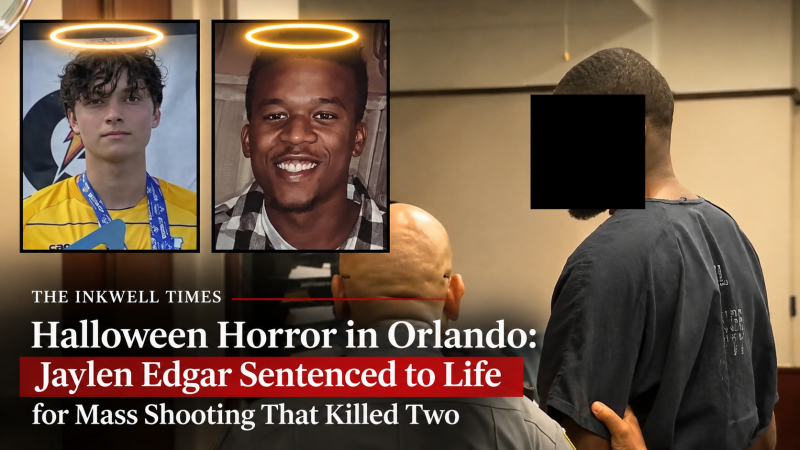
Two young men went out to celebrate Halloween in 2024. Neither returned home. Two years later, their families are still living with the consequences of a night that turned into tragedy.
By The Inkwell Times
November 4, 2026 | Orlando, Florida
A Night of Celebration Turns Deadly
Halloween is supposed to be a night of costumes, laughter, and celebration. For thousands of people gathered in downtown Orlando, Florida, on October 31, 2024, it began that way.
An estimated 75,000 people crowded the city’s entertainment district, enjoying the holiday festivities along Orange Avenue.
But shortly after 1 a.m. on November 1, the celebration turned into a nightmare.
Gunfire erupted in the crowded streets, sending terrified people running for safety. What should have been an enjoyable evening became a scene of panic, confusion, and devastation.
When the shooting stopped, two young men were dead, seven others had suffered gunshot wounds, and another person had been injured in the chaos.
The two men killed were 19-year-old Timothy Schmidt Jr. and 25-year-old Tyrek Hill.
The person responsible was Jaylen Edgar, a 17-year-old teenager who would eventually be tried and convicted as an adult.
Nearly two years later, Edgar would receive a sentence that could keep him behind bars for the remainder of his life.
What Happened on November 1, 2024?
According to investigators, the first reports of gunfire came shortly after 1 a.m. near Central Boulevard and Orange Avenue.
A second shooting was reported near Washington Street and Orange Avenue.
As people attempted to escape, officers responded to the violence unfolding around them.
Police body-camera footage captured officers apprehending Edgar shortly after the shooting.
Investigators subsequently reviewed surveillance recordings, witness accounts, and footage documenting the events.
Prosecutors argued that Edgar deliberately fired into a densely populated crowd, placing numerous lives in danger.
Nine people were struck by gunfire.
Two died.
Seven survived, although some would later describe serious and lasting injuries.
For the thousands of people who witnessed the chaos, the experience would leave memories that could not simply be erased once the streets reopened.

Remembering Timothy Schmidt Jr. and Tyrek Hill
Behind every homicide statistic is a person whose life mattered.
Timothy Schmidt Jr. was only 19 years old.
A student at the University of Central Florida, Timothy had a future ahead of him. He was at an age when many young adults are discovering who they are, building friendships, and preparing for the next chapter of their lives.
His father, Timothy Schmidt Sr., spoke about his son’s character during the sentencing proceedings in October 2026.
He remembered Timothy as a caring, generous young man who supported the people around him.
His father’s testimony illustrated the enormous loss suffered by a family forced to confront a future without their son.
Tyrek Hill was 25 years old.
His mother, Teresa Clinton, described him as a gentle giant and someone who played an important role within their family.
Despite his young age, she viewed him as a source of strength and support.
During the sentencing hearing, Clinton expressed the anguish of losing her son and the painful realization that no courtroom outcome could bring him back.
Both families lost far more than the people named in a criminal case.
They lost birthdays, holidays, conversations, milestones, and ordinary moments that should have belonged to them.
Timothy and Tyrek deserve to be remembered for the lives they lived, not merely for the violence that ended them.
Survivors Left With Lasting Injuries
Although seven people survived their gunshot wounds, survival did not necessarily mean a return to normal life.
During Edgar’s trial, five of the seven shooting survivors testified.
Among them was Anthony Berry, who described witnessing Edgar pull out a firearm and begin shooting.
Berry was shot in the head.
He later spoke about the permanent psychological consequences of the attack.
Another survivor, Jonathan Valle, suffered gunshot wounds to his head and foot.
Valle testified that he continued to experience vertigo and seizures. Even ordinary activities, including exposure to sunlight or lying down, had become difficult.
Jessica De Carvalho, another survivor, addressed the court during Edgar’s sentencing.
She described the continuing physical and emotional consequences of the shooting and her difficulty understanding how someone could commit such an act.
Their testimony revealed an important reality often overlooked in discussions about mass shootings.
The number of people killed does not fully represent the number of lives devastated.
Survivors may face years of medical treatment, chronic symptoms, psychological trauma, lost opportunities, and uncertainty about their futures.
Their suffering deserves recognition long after public attention moves elsewhere.
The Trial: Nine Guilty Verdicts
Edgar was 17 years old when the shooting occurred, but prosecutors pursued the case in adult criminal court.
He faced two counts of first-degree murder and seven counts of attempted first-degree murder, along with additional firearm-related charges.
During the trial in August 2026, prosecutors presented evidence that included surveillance recordings, eyewitness testimony, and police footage.
Edgar’s defense raised questions about his mental state at the time of the shooting.
In letters to the court, Edgar described experiencing significant emotional and psychological distress. However, his attorney acknowledged that the evidence did not establish a viable insanity defense.
Edgar ultimately chose not to testify.
On August 24, 2026, a jury found him guilty on all charges.
For the families of Timothy Schmidt Jr. and Tyrek Hill, the verdict represented an important step toward accountability.
But the legal proceedings were not over.
A sentencing hearing would determine the punishment Edgar would receive.
October 27, 2026: Three Life Sentences
On October 27, 2026, Orange County Circuit Judge Keith Carsten sentenced Jaylen Edgar to three consecutive life sentences.
Edgar, now 19, had been convicted of two murders and seven attempted murders.
Because he was under 18 when the shooting occurred, he was not eligible for the death penalty.
The court considered mitigating evidence concerning his age, psychological history, and personal circumstances before imposing the sentence.
Edgar addressed the courtroom and apologized to those affected by the shooting.
He also maintained that he had little or no memory of the events surrounding the attack.
However, the judge emphasized the devastating consequences of his actions.
Although Edgar may be eligible for future sentence review under Florida law, the consecutive sentences mean he would face at least 75 years of imprisonment before release could become possible.
The sentencing came just days before the second anniversary of the tragedy.
For two families, another Halloween would arrive without their sons.
When the Shooter Is Also a Teenager
One of the most troubling aspects of this case is Edgar’s age.
He was only 17 when he committed the shooting.
His youth raises difficult questions about juvenile violence, access to firearms, psychological intervention, and accountability.
How does a teenager reach the point of firing a weapon into a crowd?
Were there warning signs?
Could earlier intervention have prevented the tragedy?
These questions deserve serious examination, but speculation should not be mistaken for evidence.
The publicly reported proceedings did not establish a clear motive that fully explained Edgar’s actions.
His psychological history was discussed during the legal process, but mental health difficulties alone do not explain mass violence.
It is possible to recognize the importance of addressing youth violence and psychological distress while also acknowledging the gravity of Edgar’s crimes.
Being young does not erase the consequences of taking innocent lives.
And recognizing the circumstances of a defendant’s upbringing should never mean overlooking the suffering of victims and their families.
A Community Forever Changed
The Orlando Halloween shooting was not only a tragedy for the families directly affected.
It shook a community that had gathered for an annual celebration.
People attending public events should not have to wonder whether they will survive the evening.
Yet mass shootings have repeatedly forced American communities to confront that fear.
In this case, police officers were able to apprehend the shooter quickly, but their response could not undo the harm already inflicted.
The tragedy raises broader questions about firearm access, violence prevention, public-event security, and how communities support survivors after the headlines fade.
Preventing future violence requires more than responding after shots have been fired.
It requires serious attention to the circumstances that allow these tragedies to occur.
The Inkwell Times Perspective: Justice Cannot Restore What Was Taken
The sentencing of Jaylen Edgar brings a measure of legal accountability, but it cannot restore the lives of Timothy Schmidt Jr. and Tyrek Hill.
It cannot undo the injuries suffered by survivors.
It cannot erase the memories of those who witnessed the shooting.
And it cannot return two sons to the families who loved them.
What stands out to me is how young everyone involved was.
Timothy was 19. Tyrek was 25. Edgar was 17.
Three young lives became central to a tragedy that never should have happened, although only two were innocent victims whose futures were taken from them.
I believe we need to have more serious conversations about gun violence among young people. Not just when a tragedy makes national headlines, but before another family receives the devastating news that someone they love has been killed.
I also believe that discussions about a defendant’s age, background, or psychological struggles must never overshadow the people harmed by their actions.
There is room to examine the causes of violence without minimizing responsibility.
And there is room to demand accountability while recognizing that a prison sentence cannot truly repair the damage.
As Orlando marks two years since the shooting, I hope the names Timothy Schmidt Jr. and Tyrek Hill remain at the center of the conversation.
They were more than victims of a Halloween mass shooting.
They were sons, loved ones, and young men whose lives had meaning.
Their families deserved to welcome them home that night. Instead, they have spent two years learning to live without them.
That is the tragedy we must never forget.
The Inkwell Times covers true crime, criminal justice, and stories that deserve continued public attention. Our reporting seeks to center victims, survivors, and the lasting consequences of violence.
Content advisory: This article discusses homicide, mass shootings, and traumatic injuries.
Add comment
Comments