
The Last Place They Were Seen | An investigative series by The Inkwell Times
Author: Yasmin S. Chaudhary-Curtis
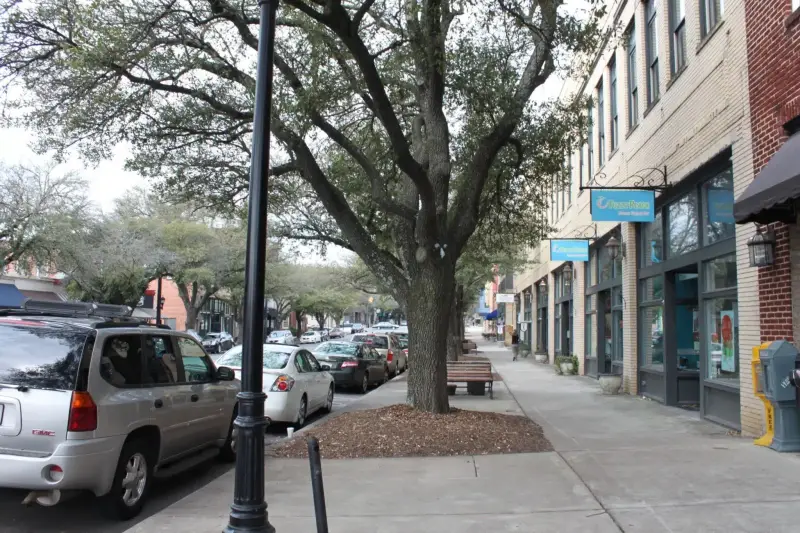
Subject: Shopping Center in Shelby Source:thisismysouth.com
Shelby, North Carolina — February 14, 2000
Valentine’s Day is often associated with love, family, and small gestures of affection. But for one North Carolina family, February 14, 2000, became the beginning of a search that has continued for more than twenty-six years.
That morning, nine-year-old Asha Jaquilla Degree was discovered missing from her family’s home in Shelby, North Carolina.
Her disappearance would eventually involve local investigators, the North Carolina State Bureau of Investigation, and the Federal Bureau of Investigation. It would generate years of searches, public appeals, and questions that remain unanswered.
More than two decades later, investigators would uncover evidence that prompted renewed searches and serious allegations in court documents.
Yet one fundamental question remains: What happened to Asha Degree?
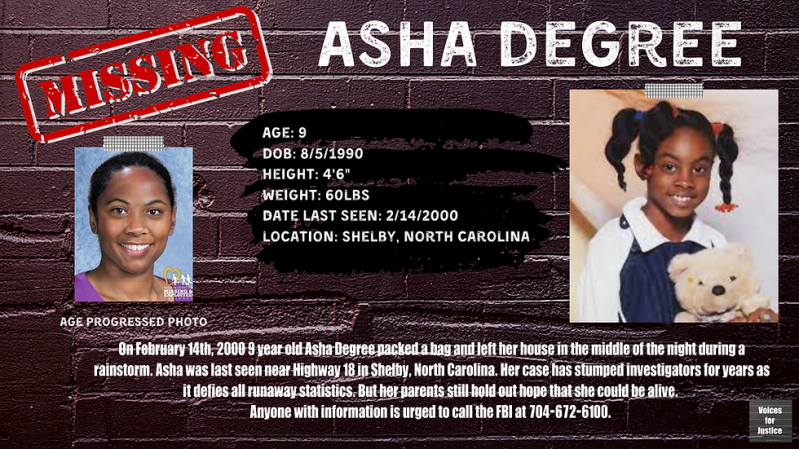
Subject: Missing Person’s Info; Asha Source:voicesforjusticepodcast.com
A Little Girl Named Asha
Asha Jaquilla Degree was born on August 5, 1990. She lived in Shelby, North Carolina, with her parents, Harold and Iquilla Degree, and her older brother.
At the time of her disappearance, Asha was a fourth-grade student at Fallston Elementary School.
She was nine years old.
Her disappearance would eventually become one of North Carolina’s most widely recognized missing-child investigations. The community came to know her affectionately as “Shelby’s Sweetheart.”
Photographs circulated by investigators show a young girl with dark eyes, braided hair, and a bright smile.
In one photograph, Asha holds a teddy bear.
It is a simple childhood portrait, but one that serves as an important reminder of the person at the center of this investigation.
Before her name appeared on missing-person posters, Asha was a daughter, a sister, and a student.
Her family expected her to grow older, celebrate birthdays, attend school, and experience the ordinary milestones of childhood.
Instead, they have spent more than twenty-six years searching for answers.
February 14, 2000: The Night Asha Disappeared
According to the North Carolina State Bureau of Investigation, Asha was last seen by her family asleep in her bed at approximately 2:30 a.m. on February 14, 2000.
Her father, Harold Degree, reportedly checked on her during the early morning hours.
Later that morning, Asha’s family discovered that she was missing.
Her disappearance was reported to authorities, prompting a search that would expand beyond her neighborhood.
Investigators subsequently received accounts from motorists who reported seeing a young girl walking along North Carolina Highway 18 at approximately 4 a.m.
The reported sightings placed the child along a roadway near Shelby during the early morning hours.
Authorities considered these accounts significant enough to include them in official descriptions of the case.
However, an important distinction must be maintained.
Although investigators have publicly identified Highway 18 as the location of Asha’s last reported sighting, the available public information does not independently establish every detail of what occurred along that road.
The precise circumstances of Asha’s departure from home remain unknown.
Investigators have not publicly established why she left, whether another person was involved at that point, or what happened after the reported sightings.
Those unanswered questions remain central to the investigation.
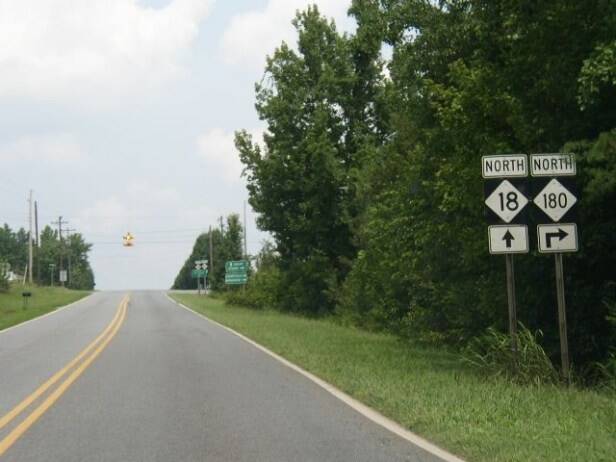
Subject: Highway 18 Source:coldcaseexplorations.com
Highway 18: The Last Reported Sightings
North Carolina Highway 18 became one of the most significant locations associated with Asha’s disappearance.
Motorists reported seeing a young girl matching her description walking along the roadway in the early morning hours.
The North Carolina State Bureau of Investigation continues to reference those sightings in its official missing-person information.
Investigators also released descriptions of clothing Asha may have been wearing, including a white shirt, white jeans, and white tennis shoes.
She may have been carrying a black backpack and a black purse featuring the cartoon character Tweety Bird.
These descriptions were intended to help investigators and members of the public identify potential evidence.
They should not be interpreted as confirmation of precisely what Asha wore or carried at every point that morning.
Highway 18 remains an important part of the case because it represents the last publicly reported location associated with her movements.
But a reported sighting does not establish a complete timeline.
It does not explain what happened afterward.
And it does not, by itself, establish who may have encountered her.
The Discovery of Asha’s Backpack
In August 2001, approximately eighteen months after Asha disappeared, her backpack was discovered in Burke County, North Carolina.
The discovery occurred roughly thirty miles from the area where motorists had reported seeing her.
The backpack became a significant piece of physical evidence in the investigation.
Its recovery also introduced another location into the case, expanding the geographic scope of investigators’ work.
The discovery raised important questions.
How had the backpack reached Burke County?
When had it been placed there?
And could the items associated with it help investigators determine what happened to Asha?
For years, those questions remained unresolved publicly.
The backpack and evidence associated with it would later become relevant to renewed investigative activity.
More Than Two Decades of Searching
The search for Asha continued long after the initial investigation.
The Cleveland County Sheriff’s Office, North Carolina State Bureau of Investigation, and FBI remained involved in efforts to determine her whereabouts.
Investigators continued to review information, pursue leads, and seek assistance from the public.
Meanwhile, Asha’s family continued to advocate for her.
Over the years, her parents participated in interviews, public appeals, and community gatherings intended to keep attention on her disappearance.
Annual prayer walks became part of those efforts.
In February 2025, family members and supporters again gathered to remember Asha and encourage anyone with information to come forward.
Her mother, Iquilla Degree, has repeatedly expressed hope that her daughter is still alive.
That hope deserves to be represented accurately, even as investigators have pursued evidence suggesting a different possibility.
The family’s beliefs and investigators’ assessments are not the same thing.
Neither should be misrepresented as an established resolution to the case.
Subject: Cleveland County Town Hall Source: Reddit
In September 2024, investigators conducted searches at multiple properties in Cleveland County, North Carolina, in connection with Asha’s disappearance.
The searches involved local, state, and federal law enforcement agencies.
The Cleveland County Sheriff’s Office confirmed that search warrants had been obtained based on physical evidence connected to the investigation.
When related court documents became public, they revealed that investigators were examining possible connections between evidence associated with Asha’s disappearance and members of a Cleveland County family.
The documents also revealed a significant change in the direction of the investigation.
Authorities stated in their search-warrant applications that they believed Asha had been the victim of a homicide.
This was an investigative assessment, not a judicial determination.
Asha’s remains had not been publicly identified, and the available records did not establish her death as a confirmed fact.
For that reason, it would be inaccurate to report that Asha was definitively murdered.
The appropriate distinction is that investigators have expressed a belief that she was killed, while the publicly established outcome of her disappearance remains unresolved.
The Evidence Described in Court Documents
Search-warrant records released in 2024 and 2025 described forensic findings involving items associated with Asha’s backpack.
According to those documents, investigators identified DNA evidence associated with individuals connected to the Dedmon family and Russell Bradley Underhill, who died in 2004.
The documents described investigative connections among the individuals, certain properties, and a vehicle examined during the investigation.
The presence of DNA associated with a person is a forensic finding that requires interpretation within the broader evidence.
It does not independently establish that the person committed a crime.
Nor does the execution of a search warrant establish guilt.
The warrants identified members of the Dedmon family as subjects of investigative interest and described investigators’ suspicions concerning Asha’s disappearance.
Members of the family have denied involvement.
As of the February 2026 reporting reviewed for this article, no arrests or criminal charges had been announced in connection with Asha’s disappearance.
That distinction is essential.
Court documents can reveal what investigators are examining and why they believe further searches are justified.
They do not automatically establish that every allegation within them is true.
The Investigation Continues in 2025
Investigative activity continued into 2025.
Additional search warrants were executed in February, including warrants seeking electronic devices and information investigators believed could be relevant to the case.
Court documents described investigators’ efforts to examine possible obstruction of justice.
These records represented further investigative steps, not proof that obstruction occurred.
Investigators also continued examining the possible relevance of vehicles associated with the case.
For years, authorities had sought information about a dark green vehicle reportedly connected to a possible sighting around the time Asha disappeared.
During the 2024 searches, investigators seized a green vehicle from a property associated with the Dedmon family.
Court documents described similarities between that vehicle and the type of automobile previously sought by investigators.
However, the public evidence reviewed does not establish that the seized vehicle transported Asha.
The relationship between the vehicle, the forensic evidence, and Asha’s disappearance remains a matter for investigators to establish.
Twenty-Six Years Later: Where the Case Stands
February 14, 2026, marked twenty-six years since Asha disappeared.
By that anniversary, the investigation had undergone significant developments, including renewed searches, forensic analysis, and the release of previously unavailable court records.
Despite those developments, Asha’s whereabouts had not been publicly established.
The investigation remained unresolved.
The most recent substantial reporting reviewed for this article, published in February 2026, indicated that no arrests or charges had been announced in connection with her disappearance.
Investigators continued to seek information.
A combined reward of $100,000 was being publicized for information leading to a conviction in the case.
The North Carolina State Bureau of Investigation continues to maintain an official missing-person listing for Asha.
For her family, the passage of time has not eliminated the need for answers.
For investigators, the central task remains determining what happened to a child who disappeared from her home in the early morning hours of February 14, 2000.
The Questions That Remain
Asha Degree’s case contains several unresolved questions that cannot responsibly be answered through speculation.
Why did Asha leave her home?
What occurred after the reported sightings along Highway 18?
How did her backpack reach Burke County?
What is the full significance of the forensic evidence described in the search warrants?
And will the investigation ultimately establish what happened to her?
These are legitimate questions.
But until reliable evidence provides answers, they must remain questions.
The existence of an investigative theory does not make it a confirmed account of events.
Likewise, the absence of a publicly announced resolution does not mean investigators have stopped working.
The distinction between what is known, what is alleged, and what remains unknown is particularly important when reporting on the disappearance of a child.
Remembering Asha Beyond the Investigation
It is easy for a long-running missing-person investigation to become defined by evidence, timelines, searches, and legal documents.
But Asha Degree was a child before she became the subject of a criminal investigation.
She was nine years old when she disappeared.
She had a family who loved her, a school she attended, and a life that should have continued beyond February 14, 2000.
The photograph of Asha holding her teddy bear is a reminder of that childhood.
More than twenty-six years have passed since her family last saw her.
The passage of time has brought new investigative developments, but it has not provided the answers her loved ones have sought.
The Last Place They Were Seen begins with a location, but its purpose is to remember the person whose absence made that location significant.
For Asha Degree, that location is a stretch of North Carolina Highway 18.
For her family, the search has never been limited to a road, a backpack, or a collection of investigative records.
It is a search for their daughter and sister.
And until her disappearance is resolved, Asha’s story remains unfinished.
Have Information About Asha Degree?
Anyone with information about Asha’s disappearance can contact:
Cleveland County Sheriff’s Office: 704-484-4888
North Carolina State Bureau of Investigation: 919-582-8477 (919-582-TIPS)
Information should be provided directly to investigators rather than circulated as unverified allegations online.
The Inkwell Times — The Last Place They Were Seen
Editorial note: This article distinguishes established case information from allegations and investigative assessments contained in search-warrant records. No person named in the investigation should be presumed guilty. The case remains unresolved in the latest substantive reporting reviewed for this article.
Add comment
Comments