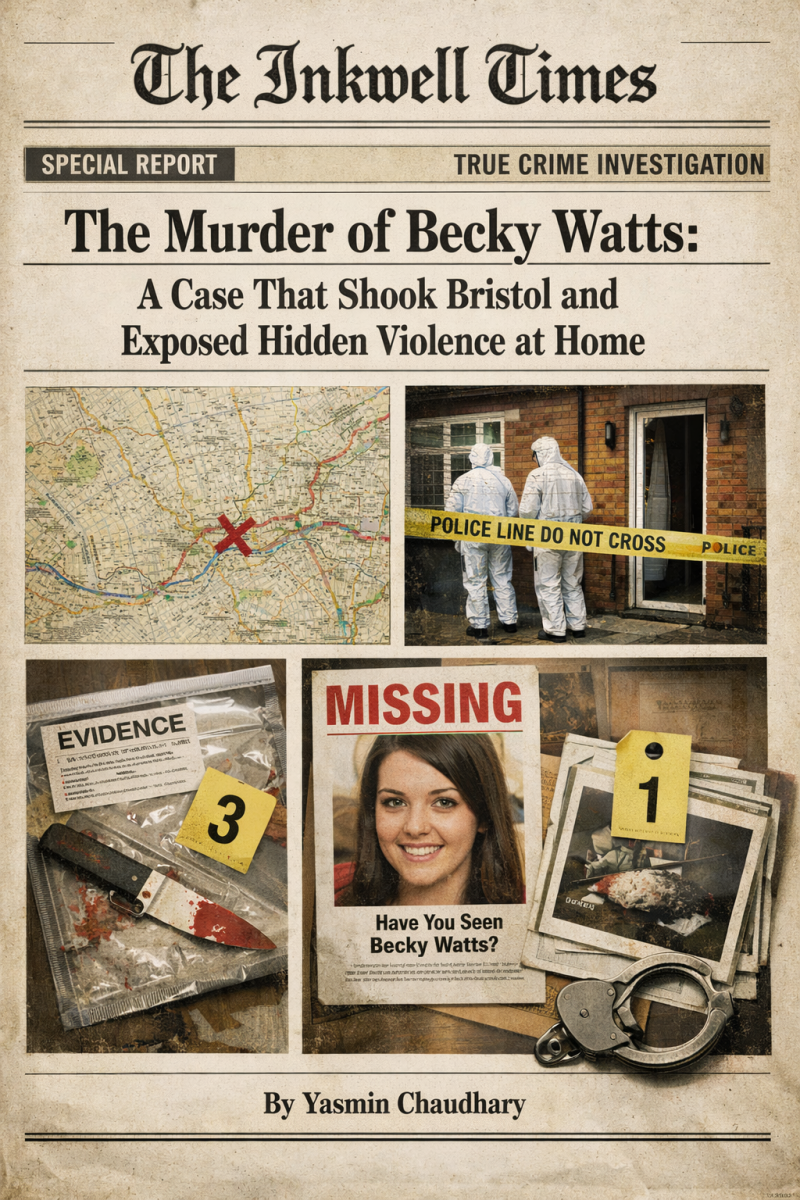
By Yasmin Chaudhary — The Inkwell Times
In February 2015, the disappearance of 16-year-old Rebecca “Becky” Watts from her home in Bristol, England, sparked a nationwide search and an outpouring of concern. What began as a missing person case quickly escalated into a murder investigation that would shock the UK and leave a lasting impact on how people think about safety within the home.
Becky’s case is often remembered not just for its tragic outcome, but for the unsettling reality it revealed: danger is not always external, and sometimes it exists much closer than anyone expects.
A Normal Day That Ended in Alarm
On 19 February 2015, Becky was last seen at her family home in St George, Bristol. At first, there was no immediate indication that anything was wrong. She had been at home that morning, and when she could not be located later in the day, her disappearance was initially treated as a missing person case.
Her family and police launched urgent appeals, and social media quickly amplified her image and name across the country. Friends described Becky as a typical teenager—quiet, familiar, and not known to have any reason to leave home without telling anyone.
But as hours turned into days, concern deepened.
There were early signs that something unusual had occurred inside the home: personal belongings were missing, and there were no clear indications that Becky had planned to go anywhere.
The Shift from Missing Person to Murder Investigation
Within days, investigators began to suspect that Becky had not left voluntarily. The focus of the inquiry shifted inward, toward people she knew and trusted.
Police arrested two individuals in connection with the case: her stepbrother, Nathan Matthews, and his girlfriend, Shauna Hoare. Both had been present in the household around the time Becky disappeared.
What initially appeared to be a disappearance quickly developed into a complex criminal investigation involving deception, conflicting accounts, and efforts to mislead authorities.
By the end of February, both suspects were formally detained as the case intensified.
The Discovery That Confirmed Fears
In early March 2015, police located Becky’s remains in Bristol following extensive searches and investigative work.
The discovery confirmed what had already become increasingly clear: Becky had been killed shortly after she was last seen.
Authorities stated that the circumstances surrounding her death indicated planning and involvement by more than one person, and the case was escalated into one of murder and conspiracy.
Inside the Investigation
As detectives pieced together events, the timeline revealed a troubling sequence involving attempts to conceal what had happened and mislead investigators during the early stages of the search.
Court proceedings later established that Becky was targeted inside her own home. The prosecution argued that there had been an intent to abduct her, but the situation escalated beyond control, resulting in her death.
The court also heard evidence that efforts were made afterward to hide what had happened and delay the investigation.
These actions formed part of the charges beyond murder, including conspiracy and obstruction of justice.
The Trial and Verdict
The trial took place at Bristol Crown Court in late 2015 and lasted several weeks. Prosecutors laid out a case built on forensic evidence, communications, and witness testimony.
The jury ultimately reached a verdict in November 2015:
- Nathan Matthews was found guilty of murder.
- Shauna Hoare was found guilty of manslaughter and other related offences.
Matthews was sentenced to life imprisonment with a minimum term of 33 years. Hoare received a 17-year sentence.
Additional convictions were secured for individuals who assisted in covering up aspects of the crime.
For Becky’s family, the outcome brought legal resolution but no emotional closure. Her father and relatives described the devastation of losing a young life in such circumstances, while also emphasizing the importance of remembering Becky for who she was in life rather than the crime that took her from them.
The Bristol community responded with vigils and memorials, including tributes near her home. Flowers, messages, and public gatherings reflected a shared sense of grief and disbelief.
Why the Case Resonated Nationally
The murder of Becky Watts became one of the UK’s most widely discussed criminal cases because it disrupted assumptions about where danger comes from.
It highlighted several difficult truths:
- That serious harm can occur within familiar domestic spaces
- That warning signs are not always recognized in time
- That individuals close to a victim can sometimes be involved in harm
The case also prompted renewed discussion about missing persons protocols and how quickly investigations should escalate when a vulnerable person disappears without explanation.
Legacy
Today, the Becky Watts case remains a reference point in UK criminal discussions, particularly around domestic trust, safeguarding, and investigative response to missing persons cases.
For many, it stands as a reminder of how quickly ordinary life can fracture, and how important it is for communities and authorities to act swiftly when something feels wrong.
But beyond the headlines and court outcomes, Becky’s story remains centered on a young life cut short—one that her family and community continue to remember with love, grief, and reflection.
Add comment
Comments
This case has always stayed with me because Becky was just a normal teenager living her everyday life. It’s heartbreaking to think about how quickly everything changed. I remember following the news when she went missing and hoping she would be found safe.
What struck me most was that the people responsible weren’t strangers. Cases like this remind us that danger doesn’t always come from outside. It’s a tragic story that still feels shocking even years later.
Every time I read about Becky Watts, I think about her family. No parent should ever have to endure something like this. The loss of such a young life is devastating.
This was one of those cases that made headlines everywhere, but behind the news reports was a real young woman whose future was taken away. That’s what makes it so sad.
The fact that Becky was only sixteen makes this case especially difficult to read about. She should have had her whole life ahead of her. It’s impossible not to feel for everyone who loved her.
I remember when this happened and being stunned by the details that came out during the investigation. It completely changed how I viewed stories involving missing teenagers.
The article does a good job of focusing on Becky rather than sensationalizing the crime. Too often people remember the perpetrators and forget the victim.
Cases like this are a reminder that we should never ignore concerns when someone suddenly disappears. The response from the community showed how many people cared and wanted to help.
Even after all these years, Becky Watts remains one of the most memorable cases in the UK for me. It’s heartbreaking from every angle.
The saddest part is thinking about all the milestones Becky never got to experience. She was at the beginning of her life, and that was taken away far too soon.
As someone who’s followed true crime cases for years, Becky Watts’ murder immediately reminded me of the murder of Samantha Runnion and several other cases where the public’s initial fears focused on strangers, only for investigators to discover that the truth was much closer to home. While the circumstances are different, Becky’s case also brought to mind the murder of Sarah Stern in the United States, where someone she knew and trusted ultimately played a central role in her death.
What makes Becky’s case so unsettling is that it shattered the common belief that home is automatically the safest place for a child or teenager. Here in America, we’ve had several high-profile cases that forced similar conversations. When details emerged that Becky had been targeted by someone within her own household, it changed the public perception of the investigation entirely.
As a true crime follower, I think that’s why this case continues to be discussed more than a decade later. It wasn’t just a missing person case or a murder investigation—it became a lesson in how appearances can be deceiving. The people around Becky, the routines of daily life, and the ordinary setting all made the tragedy harder for the public to comprehend.
What also stands out is how many people initially held onto hope that she would be found alive. I remember reading updates from the UK press at the time and seeing the same emotional roller coaster that often happens in American cases involving missing teenagers. The public desperately wants a positive outcome, which makes the eventual truth even more heartbreaking.
For me, Becky Watts’ case remains one of the most significant British true crime cases of the last twenty years because it challenged assumptions about trust, family dynamics, and where danger can come from. Those themes are unfortunately universal, whether the case happens in Bristol, Ohio, New Jersey, or anywhere else.
Melissa, thank you for sharing your perspective. The comparisons you drew are thought-provoking, and we appreciate you mentioning both Samantha Runnion and Sarah Stern. We will certainly look into those cases for potential future coverage.
We agree that Becky Watts’ case is deeply tragic. The fact that she was so young and that the events unfolded within a place that should have been safe continues to resonate with many people years later. Cases like these remind us of the importance of remembering the victims and the lives they should have had ahead of them.
Thank you for contributing to the discussion.