By Yasmin Chaudhary — The Inkwell Times
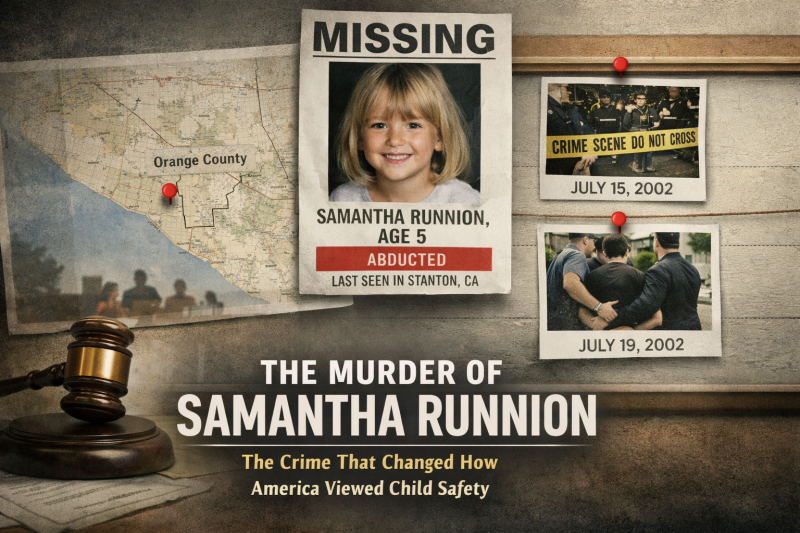
In the summer of 2002, Americans watched with growing fear as news outlets reported the disappearance of a five-year-old California girl named Samantha Runnion. What began as a frantic search for a missing child quickly became one of the most heartbreaking criminal cases of the decade.
Though more than twenty years have passed since Samantha’s death, her story continues to resonate across the United States. The case not only devastated a family and community but also influenced public conversations about child safety, abduction awareness, and the ways communities respond when a child goes missing.
Today, Samantha Runnion is remembered not only for the tragedy that took her life but also for the lasting impact her story had on efforts to protect children.
A Childhood Interrupted
Samantha Bree Runnion was born on July 26, 1996. Friends and family described her as a bright, energetic child who enjoyed spending time outdoors and playing with neighborhood friends.
In July 2002, she was living with her family in Stanton, California, a city in Orange County. Like many children her age, she spent summer afternoons playing close to home, surrounded by familiar faces and routines.
No one could have imagined how quickly an ordinary day would turn into a nightmare.
The Abduction
On July 15, 2002, Samantha was playing outside near her home with a friend when a man approached them. According to investigators, he used a common tactic often discussed in child safety education, claiming he needed help finding a lost dog.
Moments later, Samantha was taken.
Witness information provided investigators with an early description of the suspect and vehicle involved. News of the abduction spread rapidly throughout Southern California and soon across the nation. Television stations interrupted regular programming, newspapers published updates, and thousands of people followed every development in hopes that Samantha would be found alive.
A Community Searches for Answers
Law enforcement agencies launched an extensive search effort. Volunteers distributed flyers, community members organized search activities, and media coverage remained constant.
For many parents, the case struck a particularly painful nerve. Samantha had been taken while playing near her home in broad daylight, a scenario that challenged assumptions about safety and supervision.
The story quickly became one of the most closely watched criminal investigations in the country. People who had never met Samantha felt emotionally invested in bringing her home.
Unfortunately, the search would soon take a tragic turn.
The Investigation Intensifies
Within days, investigators began narrowing their focus on a suspect identified as Alejandro Avila, a resident of Lake Elsinore, California.
Authorities reported that tips from the public helped direct attention toward Avila. Investigators gathered forensic evidence and examined his movements around the time of the crime. DNA evidence ultimately became a key part of the prosecution’s case, linking him to the abduction and murder. Additional evidence connected Samantha to his vehicle.
The investigation moved quickly, and Avila was arrested only days after Samantha’s disappearance.
The speed of the arrest was viewed as a major accomplishment by investigators, who worked around the clock to identify and apprehend a suspect before additional children could potentially be harmed.
The Trial
The criminal proceedings that followed drew intense public attention.
Prosecutors argued that the evidence against Avila was overwhelming. Their case relied heavily on forensic findings, witness accounts, and records that helped establish his whereabouts during the relevant time period.
The defense challenged aspects of the prosecution’s timeline and attempted to raise questions about whether the crime could have occurred exactly as investigators described. However, jurors ultimately found the evidence persuasive.
In May 2005, a jury convicted Alejandro Avila of kidnapping and murdering Samantha Runnion.
The verdict brought relief to many who had followed the case, though it could never undo the loss suffered by Samantha’s family.
Sentencing
Following the conviction, jurors considered whether Avila should receive life imprisonment without parole or the death penalty.
After deliberations, the jury recommended a death sentence. A judge later formally imposed that sentence. Avila remains incarcerated within the California prison system, where his appeals have repeatedly failed.
The sentencing phase generated significant public discussion about justice, punishment, and the appropriate response to crimes involving children.
A Mother Turns Grief Into Action
In the years following Samantha’s death, her mother, Erin Runnion, became a prominent advocate for child safety.
Rather than retreat from public life, she dedicated herself to educating families and communities about protecting children from predators. She later founded the Joyful Child Foundation, an organization focused on prevention, education, and empowerment. The foundation promotes practical safety skills and encourages open communication between children and trusted adults.
Many supporters view the foundation as an example of transforming unimaginable grief into meaningful action.
The Impact on America
Samantha’s murder occurred during a period when several high-profile child abduction cases dominated national headlines.
As a result, public awareness of child safety issues increased dramatically. Communities organized educational programs, parents became more vigilant, and lawmakers and advocacy groups pushed for stronger protective measures.
The case also demonstrated the importance of rapid public communication during child abduction investigations. Enhanced alert systems and broader public awareness campaigns gained additional support during this period.
For many Americans who were children in 2002, Samantha’s story remains one of the defining true-crime cases of their generation.
Remembering Samantha
More than two decades later, Samantha Runnion is still remembered by those who knew her and by countless people who followed the case from afar.
Her story remains painful because of her age and the innocence associated with childhood. Yet it also endures because of the determination shown by investigators, community members, and a mother who refused to allow her daughter’s memory to fade.
While the criminal case reached its conclusion years ago, Samantha’s legacy continues through child safety advocacy and ongoing efforts to protect vulnerable children.
In the end, the story of Samantha Runnion is not only about a terrible crime. It is also about a community that came together, a family that sought justice, and a lasting commitment to ensuring that one little girl’s life would never be forgotten.
Add comment
Comments