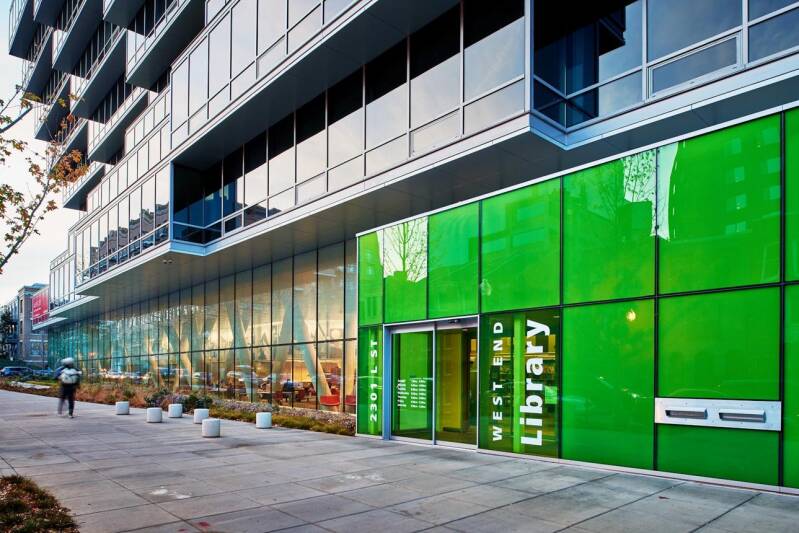
Subject: West End Library Source: Architizer
THE INKWELL TIMES | CRIME & PUBLIC SAFETY
by Yasmin Chaudhary
A Friday afternoon turns tragic
On Friday, November 6, 2026, a man was found fatally stabbed inside the West End Neighborhood Library, located at2301 L Street NW in Washington, D.C.'s West End and Foggy Bottom area.
At approximately 1:49 p.m., officers with the Metropolitan Police Department (MPD) responded to a report of a person down inside the building.
Authorities discovered an adult man suffering from stab wounds in a public restroom. He was pronounced dead at the scene.
The victim's identity had not been publicly released in the reporting available as of November 7. Police had also not announced an arrest or identified a suspect.
The location makes the incident particularly disturbing. The West End Library serves a busy residential and university-adjacent neighborhood, near George Washington University. On an ordinary weekday, patrons may visit to study, work, access public computers, attend programs, or simply enjoy a quiet environment.
Instead, the library became the scene of a homicide investigation.
What investigators have revealed
According to reporting from The Washington Post, Interim D.C. Police Chief Jeffery Carroll said investigators believed the stabbing occurred inside the restroom where the victim was discovered.
Investigators also recovered a weapon resembling a kitchen knife.
Several people were inside the library at the time. Police indicated that the incident did not create an obvious disturbance throughout the building, suggesting that some patrons may have been unaware of what had happened until authorities responded.
Early reporting contained conflicting accounts about precisely where the attack occurred. FOX 5 initially reported that investigators believed the victim had been stabbed outside and entered the library afterward. Later reporting described investigators' belief that the stabbing took place inside the restroom.
That distinction is important. The confirmed fact is that the man was found inside the library restroom with fatal injuries. The precise sequence of events remains subject to the investigation.
Police have not publicly established whether the victim knew the attacker, whether an argument preceded the stabbing, or whether the attack was targeted.
Without evidence, none of those possibilities should be presented as fact.
A police officer was already assigned to the library
One of the most significant details is that the West End Library already had a dedicated police officer assigned to the facility.
According to D.C. Public Library's official statement, that officer was present when the incident occurred.
The library also confirmed that no one else was harmed.
How security functions in public libraries. What duties was the officer performing? Were there warning signs before the attack? Could staff or security personnel have intervened, or did the incident unfold too quickly for anyone to respond?
Those questions deserve investigation, but the officer's presence alone is not evidence of negligence or a failure to follow security procedures.
Public libraries face a complicated challenge. They are designed to be accessible community spaces, not heavily restricted facilities. Their mission depends on welcoming people from different backgrounds, including residents who rely on library resources for essential services.
Introducing stricter security measures might reassure some patrons while creating new barriers for others.
The question is not simply whether libraries should have more security. It is what kinds of security measures can protect patrons and employees while preserving public access.
The library closes as staff and patrons process the tragedy
Following the homicide, the West End Library suspended operations.
D.C. Public Library announced that the branch would remain closed through Sunday, November 8, with reopening planned for Monday, November 9.
The closure was intended partly to support employees affected by the traumatic incident.
The official library notice also confirmed that no other individuals were injured.
Library employees are often expected to manage far more than books and circulation desks. They assist residents with technology, provide access to community services, help vulnerable patrons, and maintain shared spaces.
Witnessing or responding to a violent death can have lasting emotional consequences, even for people who were not physically injured.
Giving employees time away from the location acknowledges that a homicide affects more than the immediate victim.
Why violence in a library feels especially unsettling
Violent crime is disturbing wherever it occurs. But a homicide inside a library challenges the expectation that certain public places offer relative safety and stability.
Libraries are among the few indoor community spaces where people can spend time without being required to purchase anything.
They provide internet access to job seekers, quiet study areas for students, reading materials for children, and services for residents who may have limited resources elsewhere.
For some people, libraries are also places of refuge from stressful or unstable circumstances.
When violence occurs in such a setting, the consequences can extend beyond the immediate investigation. Patrons may hesitate to return. Parents may reconsider bringing their children. Employees may become more apprehensive about their working environment.
Those concerns are understandable, although one incident cannot establish that libraries generally have become unsafe.
D.C. Public Library Executive Director Richard Reyes-Gavilan emphasized that serious incidents of this nature are rare and maintained that libraries remain safe public spaces.
Both realities deserve acknowledgment: a person lost his life in a place where he should have been able to feel secure, and the broader library system continues to provide essential services to thousands of residents.
The questions that remain unanswered
As of the latest available reporting, investigators had not publicly answered several central questions:
-
Who was the victim, and what brought him to the library that afternoon?
-
Who was responsible for the fatal stabbing?
-
Did the victim and attacker know one another?
-
Where exactly did the confrontation begin?
-
What evidence, including surveillance footage, might help investigators reconstruct the events?
-
Were there any warning signs before the attack?
These are investigative questions, not suggestions that the victim or library staff contributed to the crime.
Authorities have been reviewing surveillance footage as part of their efforts to determine what happened.
Until more evidence becomes available, speculation about motive or responsibility risks spreading misinformation and unfairly implicating people who have not been connected to the investigation.
Remembering the person behind the headline
Amid discussions of police response, security policies, and public safety, one essential fact must remain at the center of this story: a man lost his life.
His name had not been publicly released at the time of this article. His background, relationships, interests, and personal circumstances were also unknown.
He was more than an unidentified homicide victim.
As the investigation progresses, there may be opportunities to learn about his life and the people who knew him. Those details should be reported respectfully and with consideration for his family.
No one should be remembered solely for the violence that ended their life.
A community deserves answers
The fatal stabbing at the West End Library has left Washington residents confronting an uncomfortable question: how can public institutions remain welcoming while ensuring that the people who use them are protected?
There is no single security measure that can prevent every act of violence.
However, transparency about the investigation, a thoughtful review of safety procedures, and meaningful support for affected employees and patrons can help the community understand what happened and what comes next.
The West End Library is scheduled to reopen Monday, November 9. Its reopening will restore an important neighborhood resource, but it will not erase what occurred there on November 6.
As investigators continue their work, the public deserves accurate information, and the victim deserves an investigation grounded in evidence rather than speculation.
A library should be a place where people feel welcome, not a place where they fear for their lives.
For one man in Washington, D.C., an ordinary Friday afternoon ended in tragedy. His death deserves answers, accountability, and remembrance.
Add comment
Comments
The mayor, DC council need to change their policies on crime. The courts progressive system is not working well either.
Well, the libraries aren't secured by police officers, and people loiter there for as long as they want. I used to go to this library daily in 2018, but I stopped because it felt creepy.
I am concerned. A lot of special-needs people frequent libraries. There are security guards at this particular one but I was not aware of what was happening. This is heartbreaking.
Even libraries aint safe. Smdh.