By Yasmin Chaudhary — The Inkwell Times
Northridge, California — New Year’s Eve 2025
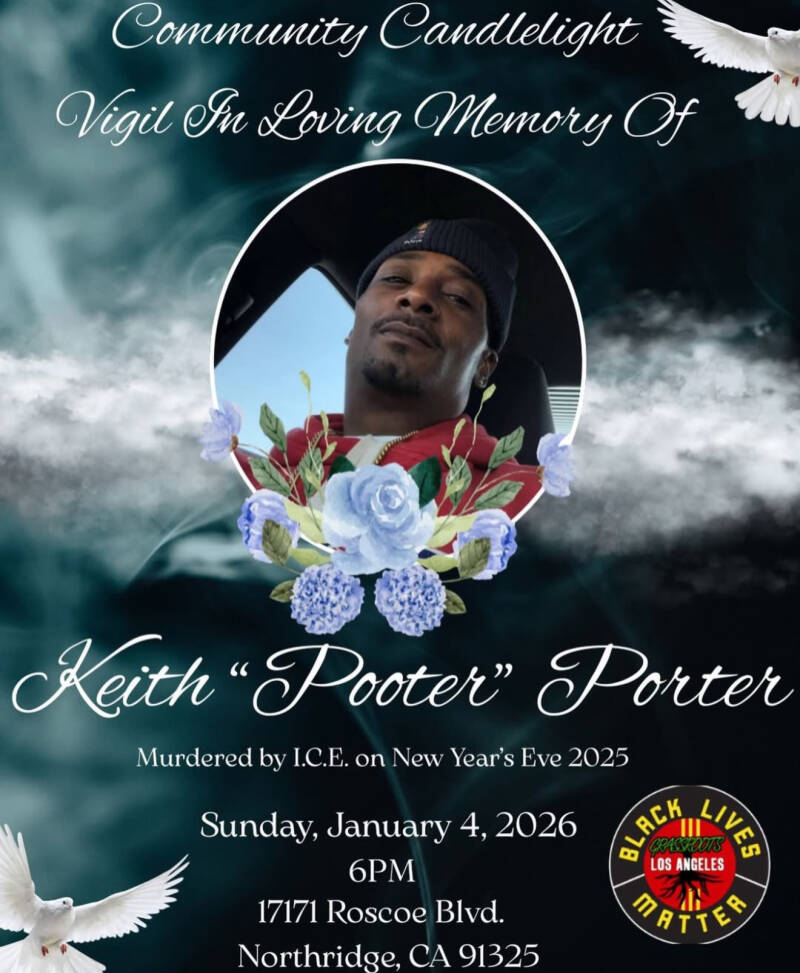
On New Year’s Eve, Keith “Pooter” Porter, a Black man celebrating the arrival of a new year, was shot and killed outside his home in Northridge, California by an off-duty Immigration and Customs Enforcement (ICE) agent.
Federal authorities have framed the shooting as an “active shooter” response. The community has rejected that narrative outright.
What remains undisputed is this: a federal immigration enforcement officer — operating off duty, outside immigration context, and armed — took a civilian life. And for many, this tragedy confirms a long-held belief that ICE operates as a violent, unaccountable force that has no place in civilian communities.
What Happened
According to law enforcement, the off-duty ICE agent encountered Porter outside an apartment complex shortly before midnight. Gunfire followed. Porter was pronounced dead at the scene. The agent was not injured.
Authorities have not released the agent’s identity, body-camera footage, or ballistic details. The agent has not publicly testified or been questioned in open court.
Civil rights groups, including Black Lives Matter Los Angeles, have demanded an independent investigation, arguing that federal agencies cannot be trusted to police themselves, particularly when the shooter is one of their own.
Why ICE’s Involvement Raises Alarm
ICE is not a traditional police agency. It was created in 2003 as part of the Department of Homeland Security and tasked with immigration enforcement — not neighborhood patrol, not civilian conflict response, and certainly not off-duty armed intervention in residential areas.
Yet ICE agents carry firearms, operate with expansive authority, and frequently function with limited public oversight.
This combination — broad power, minimal transparency, and deadly force — is precisely why ICE is so widely feared.
A Record of Abuse and Impunity
ICE’s history is riddled with documented misconduct:
- Deaths in custody: Dozens of people have died in ICE detention centers, many after being denied medical care. Government watchdogs and human rights organizations have repeatedly cited neglect, medical abuse, and dangerous conditions.
- Sexual abuse and coercion: Multiple ICE facilities have been exposed for sexual assault, forced gynecological procedures, and retaliation against detainees who speak out.
- Disappearing people: Families often lose track of loved ones moved between facilities with no notice — a practice advocates describe as legalized disappearance.
- Lack of accountability: ICE agents are rarely criminally charged, even when courts later rule their actions unconstitutional.
These are not rumors. They are findings documented by the ACLU, Human Rights Watch, the Department of Homeland Security’s own Office of Inspector General, and federal courts.
Why Communities Associate ICE With Human Trafficking
While ICE claims to combat trafficking, advocates argue the agency enables conditions that resemble it:
- Detainees are transferred across state lines without consent or warning.
- People are held for profit in private detention facilities.
- Labor inside detention centers has been exposed as exploitative, with detainees paid as little as $1 per day.
- Survivors of trafficking have been detained and deported instead of protected.
For many, the distinction between “enforcement” and state-sanctioned coercion collapses when people are stripped of agency, moved like cargo, and denied due process.
This is why activists increasingly name ICE as part of the problem — not the solution.
A Pattern, Not an Isolated Incident
The killing of Keith “Pooter” Porter is not happening in a vacuum.
It fits into a broader pattern where:
- Federal agents operate in civilian spaces
- Deadly force is used
- Information is withheld
- And communities are told to wait patiently for answers that may never come
When ICE is involved, trust is already broken.
Why “Internal Investigations” Are Not Enough
ICE answers to the same federal structure that authorizes its power. Internal reviews, delayed disclosures, and sealed findings do not meet the standard of justice — especially when a Black civilian is killed.
Independent oversight is not optional. It is necessary.
Without transparency:
- The public cannot verify the narrative.
- Families cannot grieve with truth.
- And accountability remains theoretical, not real.
Say His Name
Keith “Pooter” Porter deserved to live. He deserved a new year. He deserved safety in his own neighborhood.
Instead, his death now stands as another warning about what happens when federal agencies operate without meaningful limits.
The question is no longer whether ICE should be reformed.
It is whether an agency so deeply associated with abuse, fear, and death should exist at all.
A candlelight vigil has been organized in Porter’s name — not only to mourn his life, but to demand that this killing not be buried under bureaucratic language and federal silence.
Say his name.
Demand accountability.
And refuse to accept violence as policy.
Add comment
Comments
Prayers 🙏🏿