Author’s Note
This article examines House Bill 1232 and the concerns raised by legal experts, reproductive rights advocates, healthcare professionals, and members of the public regarding its potential impact. Because the bill has not become law, many of the consequences discussed are based on how similar legislation has been interpreted elsewhere and on concerns about how courts could apply the proposed language in the future.
The purpose of this article is not to predict with certainty what will happen if the bill passes, but to explore the legal, medical, and social questions that have emerged during the debate. Readers are encouraged to review the bill’s text, consider perspectives from multiple sides of the issue, and draw their own conclusions.
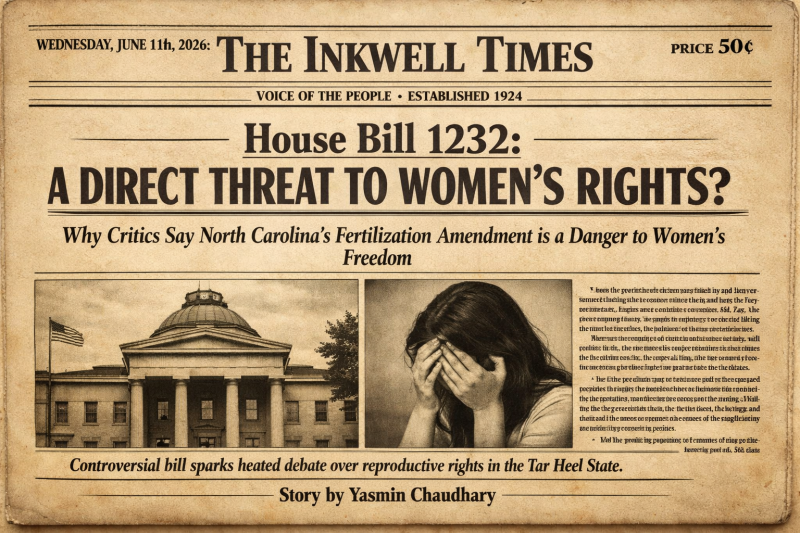
By Yasmin Chaudhary — The Inkwell Times
In recent weeks, North Carolina House Bill 1232 has ignited fierce debate across the state and beyond. Supporters describe the proposal as an effort to protect unborn life. Opponents, however, see something far more sweeping: a constitutional amendment that could fundamentally alter the legal status of women, reproductive healthcare, birth control, fertility treatment, and pregnancy itself.
At the center of the controversy is a simple but far-reaching idea: the bill would recognize legal personhood beginning at fertilization.
While that phrase may sound straightforward, legal experts, reproductive rights advocates, physicians, and many residents warn that the consequences could extend far beyond abortion.
What Does House Bill 1232 Do?
House Bill 1232 seeks to amend North Carolina’s constitution to declare that human life begins at fertilization and that a fertilized egg is entitled to the same legal protections as a person.
If adopted, this principle would not merely affect abortion laws. Constitutional amendments carry immense legal weight, often influencing how courts interpret existing statutes and future legislation.
The proposal’s language has raised alarm because it could create legal conflicts involving reproductive healthcare, miscarriage investigations, fertility treatments, emergency medical care, and contraception.
Critics argue that once a fertilized egg is granted full legal personhood, nearly every decision involving pregnancy becomes subject to new legal questions.
Why Opponents Are Calling It a “War on Women”
The phrase “war on women” is often used in political debate, but opponents of HB 1232 argue that the bill fits that description because its practical effects would fall overwhelmingly on women and girls.
A fertilized egg cannot become the subject of criminal investigation on its own. A woman can.
A fertilized egg cannot face prosecution. A woman can.
A fertilized egg cannot be monitored by the state. A woman can.
Critics contend that personhood laws shift government scrutiny toward pregnant individuals, potentially placing ordinary medical decisions under legal examination.
For many opponents, the concern is not merely about abortion. It is about whether women retain full control over their own healthcare and bodily autonomy.
Potential Consequence #1: Abortion Could Be Treated as Homicide
One of the most controversial aspects of the proposal is the possibility that abortion could be treated as the killing of a legally recognized person.
If fertilization establishes legal personhood, opponents argue that abortion restrictions could become significantly broader than those currently in place.
In some interpretations, abortion providers could face severe criminal penalties. Questions have also been raised about whether women themselves could become targets of investigation or prosecution.
Even if courts ultimately limited such outcomes, critics note that the uncertainty alone could dramatically alter access to reproductive healthcare.
Potential Consequence #2: Threats to IVF and Fertility Treatments
Many families rely on in vitro fertilization (IVF) to conceive.
During IVF procedures, multiple embryos are often created. Some may not be implanted, and others may be frozen indefinitely.
If every fertilized embryo is considered a legal person, opponents warn that routine fertility practices could become legally vulnerable.
Fertility clinics could face new restrictions. Medical professionals might be forced to alter treatment protocols. Some patients could lose access to reproductive options they currently depend upon.
For couples struggling with infertility, the consequences could be profound.
Potential Consequence #3: Questions Surrounding Birth Control
Another major concern involves certain forms of contraception.
Although birth control methods operate differently, critics worry that any contraceptive perceived as interfering with a fertilized egg could become a target for future legal challenges.
This concern has fueled widespread anxiety online, particularly among women who rely on long-term contraceptive methods.
Whether courts would ultimately uphold such restrictions remains uncertain. However, opponents argue that creating constitutional personhood at fertilization opens the door to those legal battles.
Potential Consequence #4: Increased Scrutiny of Pregnancy Loss
Miscarriage is tragically common.
Medical experts estimate that many pregnancies end naturally before birth, often without any action by the pregnant person.
Opponents fear that personhood laws could increase pressure on law enforcement and prosecutors to investigate pregnancy losses under certain circumstances.
Most women who experience miscarriage are already coping with grief, physical recovery, and emotional trauma.
Critics argue that adding the possibility of legal scrutiny could create fear and discourage people from seeking medical care.
Potential Consequence #5: Conflicts During Medical Emergencies
Pregnancy complications can become life-threatening.
Doctors sometimes face situations in which delaying treatment increases the risk to a patient’s health or life.
Opponents worry that personhood language could create confusion about when physicians may intervene without fear of criminal or civil liability.
Medical organizations in multiple states have previously raised concerns that restrictive reproductive laws can cause doctors to hesitate while seeking legal guidance during emergencies.
When minutes matter, uncertainty can carry serious consequences.
The Deadly Force Controversy
One of the most debated portions of the bill involves language discussing the right to defend human life, including through deadly force under certain circumstances.
Critics argue that the wording creates troubling ambiguities regarding how such provisions could be interpreted if fertilized embryos are granted full legal personhood.
Legal scholars and advocacy groups have questioned whether the language could generate dangerous legal arguments involving abortion providers, pregnant women, or others involved in reproductive healthcare.
Supporters of the bill dispute some of these interpretations, but the controversy has become one of the primary reasons the proposal has drawn national attention.
Supporters See It Differently
Supporters of HB 1232 argue that the bill is fundamentally about protecting unborn life.
They contend that every human being deserves legal protection from the earliest stage of development and that society has a moral obligation to defend vulnerable lives.
For supporters, the legislation represents a logical extension of pro-life principles.
For opponents, it represents an unprecedented expansion of state authority into reproductive healthcare.
The divide reflects a broader national debate that has intensified in the years since Roe v. Wade was overturned.
Why This Debate Matters Beyond North Carolina
Even if House Bill 1232 never becomes law, its significance extends beyond a single state.
Personhood proposals have appeared in legislatures across the country for years. Each new effort tests how far states are willing to go in defining when legal rights begin and how those rights interact with the rights of women.
The outcome of these debates could influence future legislation, court decisions, and public policy nationwide.
Final Thoughts
House Bill 1232 is about more than abortion.
At its core, it asks a fundamental question: when legal rights begin, whose rights take priority, and how far government power should extend into personal medical decisions.
To supporters, the bill protects human life.
To critics, it threatens decades of reproductive rights and could place women under unprecedented legal scrutiny.
Regardless of where one stands politically, the proposal demonstrates how a few lines of constitutional language can have consequences reaching far beyond the legislature and into the daily lives of millions of women and families.
Add comment
Comments
We all know that some men are going to use this as an excuse to unaluve their wives